Al amanecer, se enteraron de que la boda nunca había sido lo más caro a lo que había renunciado.
El sonido de la palma de Lauren golpeando mi cara fue lo suficientemente fuerte como para silenciar a casi doscientas personas.
Durante un extraño instante, escuché todo lo que vino después con una claridad asombrosa.
Un tenedor golpeó un plato de porcelana.
Alguien jadeó.
El saxofonista que estaba cerca de la pista de baile bajó su instrumento.
El hielo se movía dentro de un vaso olvidado.
Y en algún lugar detrás de mí, una anciana susurró: “Oh, Dios mío”.
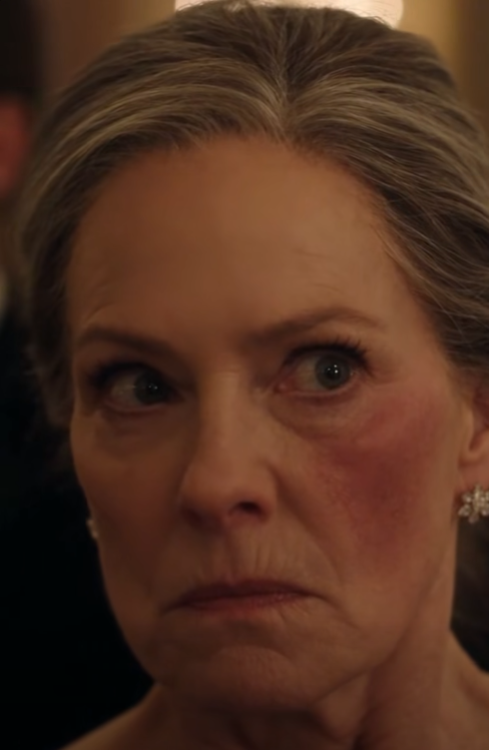
Sentí que me ardía la mejilla bajo las lámparas de araña.
Lauren estaba a pocos centímetros de distancia, con la mano aún suspendida cerca del hombro, su vestido de novia blanco resplandeciendo bajo cientos de pequeñas luces.
Pero la bofetada no fue lo que me rompió el corazón .
Eso ocurrió tres segundos después.
Me volví hacia mi hijo.
Michael permanecía de pie junto a su nueva esposa con la expresión de un hombre atrapado entre dos desastres.
Esperé a que se acercara a mí.
Esperé a que me preguntara si estaba bien.
Esperé a que el niño que había criado apareciera dentro del hombre de treinta y un años que me miraba fijamente.
En cambio, bajó la voz.
“Mamá, por favor.”
Sus ojos se dirigieron hacia los invitados que observaban.
“Vete a casa.”
Lo miré fijamente.
Detrás de Michael estaban las flores que yo había pagado.
Sobre él brillaban las lámparas de araña del salón de baile que yo había pagado.
Sobre las mesas estaban las cenas que yo había pagado.
Afuera esperaban los autos que yo había pagado.
Arriba me esperaba la suite nupcial que había pagado.
Y la mujer que estaba a su lado me acababa de pegar porque me negué a comprarle a su padre una botella de champán que costaba más que la primera cuota mensual de mi hipoteca.
Sin embargo, mi hijo parecía avergonzado de mí.
Ella no.
A mí.
—¿Vete a casa? —pregunté.
Michael tragó saliva.
“Por favor, no empeores las cosas.”
Algo dentro de mí se quedó completamente quieto.
Durante treinta y un años, me dediqué a asegurarme de que la vida de Michael nunca empeorara.
Cuando su padre murió repentinamente cuando Michael tenía diecisiete años, yo lo mantuve fuerte mientras yo misma me derrumbaba.
Cuando aumentaron las tasas de matrícula durante su segundo año de universidad, tuve que trabajar horas extra.
Cuando en su primer apartamento le exigieron un depósito de seguridad que él no tenía, yo lo pagué.
Cuando se le averió la transmisión seis meses después de graduarse, le transferí el dinero incluso antes de que terminara de pedírmelo.
Cuando perdió su primer trabajo, le compré comida y, discretamente, pagué su seguro.
Cuando le propuso matrimonio a Lauren y me dijo que querían una boda sencilla, le creí.
Aquella sencilla boda acabó convirtiéndose en un evento que costó más de lo que algunas personas ganaron en tres años.
Vendí el último terreno que me dejó mi esposo David para ayudar a pagarlo.
Michael conocía esa tierra.
Había pescado allí con su padre.
En una ocasión, él había ayudado a David a marcar el lugar donde algún día podría ubicarse un porche.
David y yo soñábamos con jubilarnos allí.
Dos mecedoras.
Una casa pequeña.
Café con vistas al lago.
Los nietos corriendo entre los árboles.
David murió antes de que pudiéramos construir nada de eso.
For fourteen years after his death, I kept that land because owning it felt like keeping one unfinished promise between us alive.
Then Michael needed money for his wedding.
At least, that was what I told myself.
So three months earlier, I sold David’s land.
I cried alone in my car after signing the deed.
Then I wiped my face and transferred most of the proceeds into the wedding account.
I never told Lauren.
Michael knew.
And now he stood beneath a ceiling sparkling with money from his father’s unfinished dream and asked me to leave because defending me might embarrass his bride.
I picked up my purse.
“Okay.”
Relief crossed Michael’s face.
That expression hurt worse than everything else.
He thought I had surrendered.
Again.
I crossed the ballroom while people pretended not to stare.
Nobody stopped me.
Inside the women’s restroom, I locked myself in a stall and gripped my purse until my trembling finally slowed.
When I looked into the mirror, a red mark had begun spreading across my cheek.
I touched it once.
Then I laughed.
It was not because anything was funny.
It was because I suddenly understood something that had taken me thirty-one years to learn.
I had confused protecting my son with loving him.
Every consequence that approached Michael, I had softened.
Every financial mistake, I had cushioned.
Every emergency, I had helped resolve.
Every difficult conversation, I had postponed.
Even this wedding had become another problem his mother was expected to solve with a checkbook.
My phone was already in my hand when I opened the folder containing the contracts.
The venue.
The band.
The premium bar.
Transportation.
The midnight food service.
The newlywed suite.
Sunday brunch.
Almost everything still remaining had been booked under my name.
I called the estate’s event director.
“Mrs. Porter?”
“Mr. Reynolds, I need to change my authorization.”
Something in my voice made him immediately serious.
“Are you all right?”
“The bride hit me.”
Silence filled the line.
Then he asked carefully, “She physically struck you?”
“Yes.”
“Do you need security?”
“No.”
I looked at myself in the mirror.
“I’m leaving.”
“What would you like us to do?”
I closed my eyes.
For one last second, I saw Michael at seventeen, crying against my shoulder after his father’s funeral.
Then the image disappeared.
In its place stood the man who had just chosen champagne, appearances, and silence over his mother.
“Stop every remaining service that requires my approval.”
Mr. Reynolds hesitated.
“The scheduled dinner service is already underway.”
“I’m not touching anything guests have already received.”