Chapter 1
The first person to tell the Black teenager that she did not belong in first class was not an airline employee.
That almost made it worse.
He was simply a stranger.
A stranger who had looked at her for perhaps four seconds before deciding he understood enough about her to tell her where she belonged.
Flight 212 was still boarding at John F. Kennedy International Airport when the fourteen-year-old stepped into the aircraft.
She carried one burgundy travel bag.
A charcoal backpack rested over one shoulder.
Her passport sat inside a slim document wallet beneath her sweater.
And in her right hand was the boarding pass she had checked at least six times since entering the airport.
Seat 2A.
First class.
Window.
Her father had booked it himself.
She had originally complained about that.
“I don’t need first class.”
Her father had barely looked up from the tablet on his desk.
“You’re flying overnight by yourself.”
“I flew alone last summer.”
“Domestic.”
“It still had wings.”
That had made him smile.
“This is international.”
“So?”
“So I want you somewhere the cabin crew can keep an eye on you.”
“I’m fourteen, not four.”
“I noticed.”
She had folded her arms.
He had finally set the tablet aside.
“Listen.”
The change in his tone had stopped the argument.
Not because it became stern.
Because it became serious.
“You’re capable.”
“I know.”
“You’re smart.”
“I know.”
“You’re also still my daughter.”
She had tried not to smile.
“That sounds like your problem.”
“It is an expensive problem.”
She had laughed.
He had not changed the ticket.
So now she was boarding Flight 212 wearing a charcoal sweater, tailored trousers, and black sneakers while adults in polished shoes and business suits moved around her.
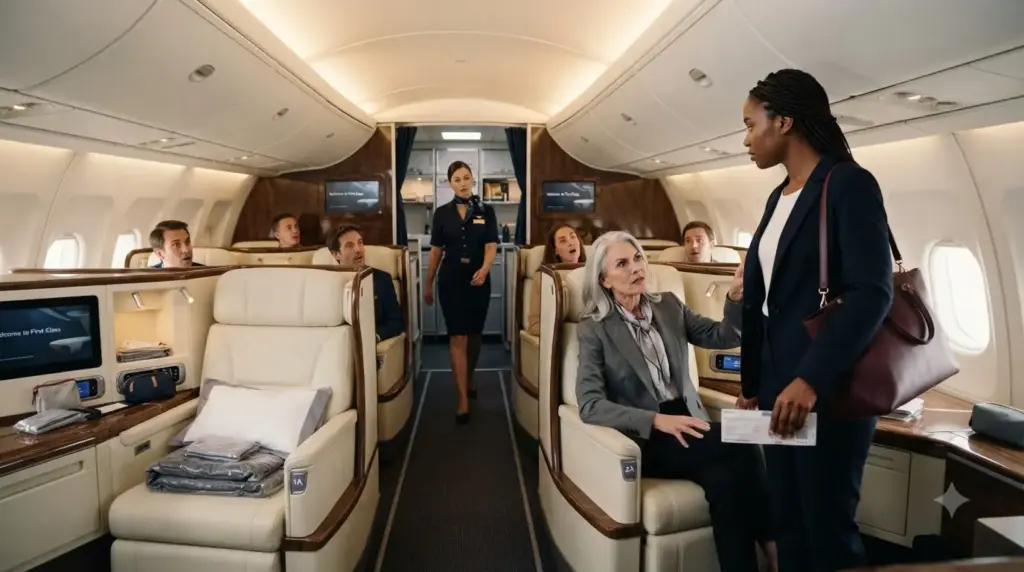
The first-class cabin was quiet compared with the main cabin behind it.
Cream leather seats.
Walnut trim.
Wide armrests.
Personal lamps.
Passengers speaking softly into phones before departure.
The Black teenager stopped beside row two.
Her boarding pass said 2A.
The small illuminated number beside the window said the same.
Someone was already sitting there.
A white executive in his late fifties occupied the seat as if he had been there for hours.
Silver hair.
Custom pinstripe suit.
Expensive watch.
Polished leather shoes.
A briefcase rested across his knees.
His suit jacket had been folded carefully beside him.
A financial newspaper waited on the console.
He did not appear lost.
That was the teenager’s first observation.
Her second was that seat 2B, immediately beside him, was empty.
She stood in the aisle.
“Excuse me.”
The executive looked up.
His eyes moved first to her face.
Then her clothes.
Then the burgundy bag.
Then behind her.
As if searching for the adult who must have accompanied her.
No adult appeared.
The teenager lifted her boarding pass.
“I think you’re in my seat.”
The executive barely glanced at the paper.
“No.”
She waited.
That was all he said.
“No.”
She checked the number again.
“Mine says 2A.”
The executive looked toward the rear of the aircraft.
“Economy is farther back.”
The teenager said nothing for a second.
At first, she wondered whether she had misunderstood.
Maybe he thought she had asked where economy was.
Maybe he had not heard.
Then he looked directly at her.
“You don’t belong in first class.”
Capítulo 2
Las palabras fueron bajas.
Eso las empeoraba.
No gritó.
No se rió.
Habló con la seguridad relajada de quien da indicaciones.
La adolescente sintió cómo el calor le subía por las orejas.
Había experimentado versiones de esto antes.
Una dependiente de boutique que la seguía de un estante a otro ignorando a otras dos chicas.
Una empleada del hotel que le preguntó si estaba esperando a alguien cuando estaba sentada en un salón privado con su padre.
Una mujer en una cena benéfica que le entregó un vaso vacío porque supuso que trabajaba en catering.
Normalmente, los adultos a su alrededor acababan dándose cuenta.
Entonces la situación cambió.
A veces llegaba una disculpa.
A veces llegaban explicaciones.
A veces nadie admitía que había pasado algo.
Su padre le había enseñado a no gastar energía discutiendo con personas decididas a malinterpretar lo que habían hecho.
Primero los hechos.
Siempre hechos.
Levantó su tarjeta de embarque.
“Mi asiento es 2A.”
El ejecutivo suspiró.
“Entonces alguien cometió un error.”
“No, señor.”
Miró hacia el asiento vacío del pasillo.
“Tu asiento puede ser 2B.”
Entrecerró ligeramente los ojos.
“¿Viajas solo?”
La pregunta no tenía nada que ver con el asiento.
“Sí.”
Se recostó.
Esa respuesta pareció confirmarle algo.
“Entonces te sugiero que preguntes a uno de los asistentes dónde te han trasladado.”
“No me movieron.”
“Los niños son reasignados todo el tiempo.”
Casi le corrigió.
Luego decidí no hacerlo.
Quería discutir.
No le daría ninguna.
“¿Puedo ver tu tarjeta de embarque?”
El ejecutivo la miró fijamente.
“¿Qué?”
“Para comprobar si eres 2B.”
Un joven al otro lado del pasillo dejó de ajustarse el cinturón de seguridad.
Una mujer con una americana crema bajó un poco el móvil.
El ejecutivo se dio cuenta de la atención.
Su rostro se endureció.
“¿Sabes quién soy?”
El adolescente le miró.
“No.”
Algo en esa respuesta le ofendió más que cualquier otra cosa.
Acomodó el maletín en su regazo.
“Soy el socio director de uno de los mayores grupos de consultoría de Manhattan.”
El adolescente esperó.
Continuó.
“Mi empresa gasta casi tres millones de dólares al año en viajes corporativos.”
Ella asintió una vez.
“Eso suena a que tu empresa compra muchos billetes de avión.”
Al otro lado del pasillo, el joven tosió.
Sonaba sospechosamente a risa.
El ejecutivo se volvió hacia él.
El joven de repente se interesó por la tarjeta de seguridad.
El adolescente permaneció de pie.
El ejecutivo la miró de vuelta.
“No tienes ni idea de con quién estás hablando.”
Miró el asiento 2A.
“Tampoco has preguntado con quién hablas.”
La mujer de la americana crema miró completamente hacia arriba.
Dos pasajeros de la fila detrás habían dejado de hablar.
El ejecutivo se dio cuenta.
Su mandíbula se tensó.
“Esto es ridículo.”
Una azafata salió de la cocina de proa.
Tenía unos cuarenta años, vestía el uniforme azul marino de la aerolínea con una bufanda plateada estrecha.
Su expresión seguía siendo profesionalmente agradable.
“Buenas noches. ¿Todo bien?”
El ejecutivo respondió antes de que el adolescente pudiera hacerlo.
“Esta niña está confundida con su asiento.”
El adolescente le miró.
No miró atrás.
La azafata se volvió hacia ella.
“¿Puedo ver tu tarjeta de embarque?”
“Por supuesto.”
El adolescente se lo entregó.
El asistente lo leyó.
El adolescente observó sus ojos.
Ciudad de salida.
Destino.
Número de vuelo.
Siéntate.
Luego apellido.