“Do not make the mistake of thinking quiet means weak.”
The boys straightened.
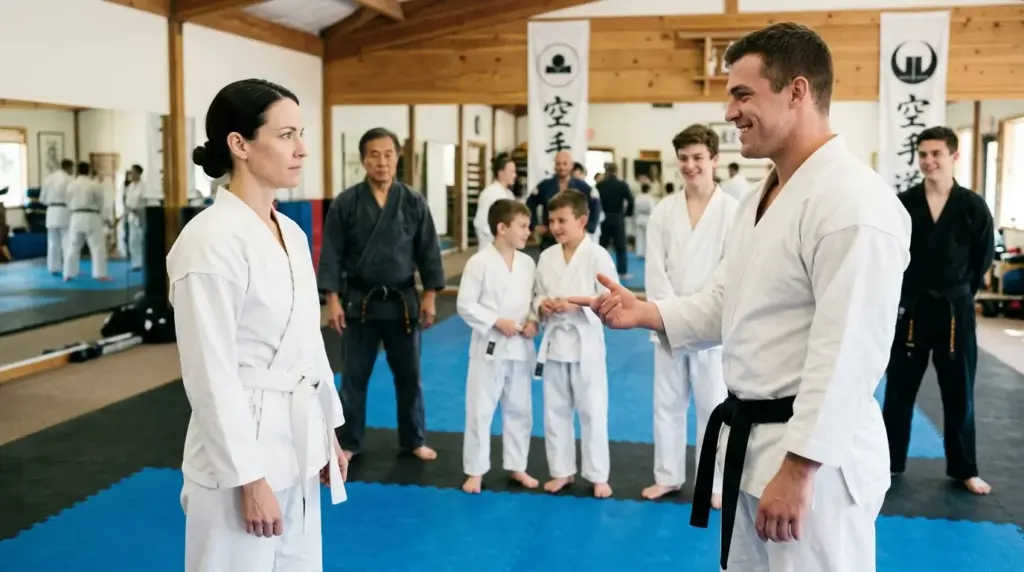
Ryan walked to the new student.
“First class?”
She nodded.
“Welcome,” he said. “You can stand over here. Nobody is going to rush you.”
From across the room, Claire saw it.
She did not smile broadly.
That was not her way.
But her eyes softened.
Progress rarely announces itself like a championship.
Sometimes it sounds like one formerly arrogant man making sure someone new feels safe.
A year later, Redwood hosted an open mat for charity.
The event raised money for a local shelter that helped women and children leaving abusive homes. Claire taught a session on boundaries and escape. Daniel taught falling safely. Ryan taught controlled pad holding and spent twenty minutes explaining to teenage boys that being strong was not an excuse to be careless.
At the end of the day, Ethan, now taller and more confident, asked Claire to spar.
“Controlled?” she asked.
He nodded quickly.
“Very controlled.”
They moved lightly.
Ethan did well.
Not because he landed anything meaningful on her.
He did not.
But because he breathed, adjusted, and laughed when she caught him leaning too far forward.
When the round ended, he bowed properly.
“Thank you.”
Claire bowed back.
“You have improved.”
He beamed.
Ryan watched from the wall.
Daniel stood beside him.
“You know,” Daniel said, “the old you would have been jealous watching that.”
Ryan nodded.
“Yeah.”
“And now?”
Ryan looked at Ethan, then at Claire.
“Now I’m glad he didn’t quit.”
Daniel nodded.
That was worth more than any trophy in the front window.
Years passed.
People still told the story of the night Claire Bennett walked onto the mat in a white belt.
Some told it like a dramatic twist.
The dojo’s best fighter picked a quiet woman for an easy spar, and one move silenced the entire room.
Some told it like a lesson in underestimation.
Never judge by appearances.
Some told it like revenge.
The arrogant champion finally got dropped.
Claire understood why those versions survived.
They were simple.
Sharp.
Satisfying.
But they were not the whole truth.
The real story was not that Claire could throw Ryan.
Plenty of people could throw someone.
The real story was that she threw him without injuring him.
The real story was that Ryan, humiliated in front of the room, still had enough character left to change.
The real story was that Daniel Park finally admitted winning had made him cowardly, and then did the harder work of rebuilding what he had allowed to rot.
The real story was that a fifteen-year-old boy learned martial arts did not have to mean enduring pain silently.
The real story was that a dojo remembered its own banner.
Discipline.
Respect.
Control.
Words are easy to hang on a wall.
They are harder to enforce when the person violating them is talented, popular, profitable, or feared.
That is why every training room eventually has to answer a question.
Who is protected here?
The strongest egos?
Or the people who came to learn?
For a while, Redwood Martial Arts Academy had answered badly.
Then a quiet woman in a plain gi stepped onto the mat and held up a mirror.
Not with a speech.
Not with anger.
With one move.
A step off the line.
A hand on the shoulder.
A foot behind the heel.
A body placed gently but unmistakably on the mat.
The sound of Ryan hitting the floor became a kind of punctuation in the dojo’s history.
There was before it.
And after it.
Before, students believed skill meant being able to dominate.
After, they began learning skill meant being able to choose.
Choose how hard.
Choose when to stop.
Choose whether pride gets to decide what the body does.
Choose whether a partner leaves better or smaller.
Years later, a new student might walk into Redwood with rounded shoulders and nervous eyes, unsure where to stand. Someone would greet them. Someone would explain how to bow. Someone would show them how to fall without laughing when they did it wrong.
And above the entrance, beneath the old red banner, Daniel added a smaller sign.
It read:
The mat is not a stage for ego. It is a place where strength learns responsibility.
Claire saw it one evening and nodded.
“You finally wrote something true,” she said.
Daniel laughed softly.
“Took me long enough.”
Ryan, now an assistant coach, was holding pads for a twelve-year-old girl near the mirrors. The girl hit hard, lost her balance, and looked embarrassed.
Ryan steadied the mitts.
“Good power,” he said. “Now let’s learn where to put it.”
Claire watched for a moment.
Then she picked up her bag and walked toward the door.
She still wore a white belt when she visited Redwood.
Not because anyone believed she was a beginner anymore.
Because it reminded everyone, including her, that rank was never the point.
The point was what you did with what you knew.
On her way out, Ethan called from the mat.
“Sensei Claire?”
She turned.
He hesitated, then asked, “How long does it take to really learn control?”
Claire looked at the room.
At Daniel.
At Ryan.
At the new students.
At the old banner.
At the place that had once mistaken silence for weakness and now taught people to listen before they moved.
Then she answered honestly.
“Your whole life.”
Ethan nodded as if that made sense.
Claire stepped outside into the cool Sacramento evening.
Behind her, the dojo doors closed softly.
Inside, training continued.
Feet moved across the mat.
Les serviettes ont sauté.
Les élèves s’inclinèrent.
Des voix corrigéaient, encourageaient, s’excusaient, et réessayaient.
Personne ne restait silencieux par peur.
Plus maintenant.
Et cela, plus que le lancer, plus que le souffle, plus que le champion humble sur le dos, c’était la vraie victoire.
Une pièce avait appris à entendre le silence sans le confondre avec une faiblesse.