Her first pitch reached 92.0 and hit the target.
Her second reached 92.4 but missed the corner by two inches.
The square flashed red.
The crowd groaned.
Her third pitch was perfect.
The combined score fell short.
Afterward, a reporter asked whether she was disappointed.
“Yes,” Nia said.
The reporter waited for an inspirational statement.
Nia gave none.
“I missed.”
“What did your father say?”
“He said the target did not move.”
“Will you try again?”
“Yes.”
At fifteen, she returned.
Her velocity had increased, but a growth spurt affected her release point.
She missed two targets.
Some online commentators said the Harbor performance had been a lucky day.
Others said girls matured differently and she had already reached her limit.
Nia read the comments until Devin took her phone away.
“You told me not to let people erase results,” she said.
“They are not erasing them.”
“They’re saying it was luck.”
“The scoreboard still exists.”
“What if I never throw that well again?”
Devin sat beside her on the empty bleachers of the public field.
“Then you threw that well once.”
“That’s enough?”
“It has to be.”
She looked toward the mound.
“Was your record enough?”
“No.”
“Why?”
“Because I needed it to repair everything that happened after.”
He rested his hands on his knees.
“A number cannot do that.”
Nia thought about his answer.
“Do you wish you’d never pitched that day?”
Devin looked at her.
“No.”
“Even with your shoulder?”
“I wish the adults had protected the kid who pitched.”
He nodded toward her.
“That is different from wishing the kid had stayed home.”
At sixteen, Nia stopped chasing the radar number.
Her velocity settled in the low nineties.
She developed a changeup and a sharp breaking ball.
She learned to hold runners, field bunts, and pitch when her fastball command disappeared.
Scouts began describing her as a complete pitcher instead of a viral story.
Some colleges recruited her.
A professional women’s baseball league invited her to developmental camps.
Several independent men’s programs evaluated her honestly.
She no longer needed every person to believe the same future was possible.
She needed a fair field on which to discover it.
Four years after she first raised her hand, Nia returned to Harbor Field at seventeen.
The Reed Standard challenge remained part of the showcase.
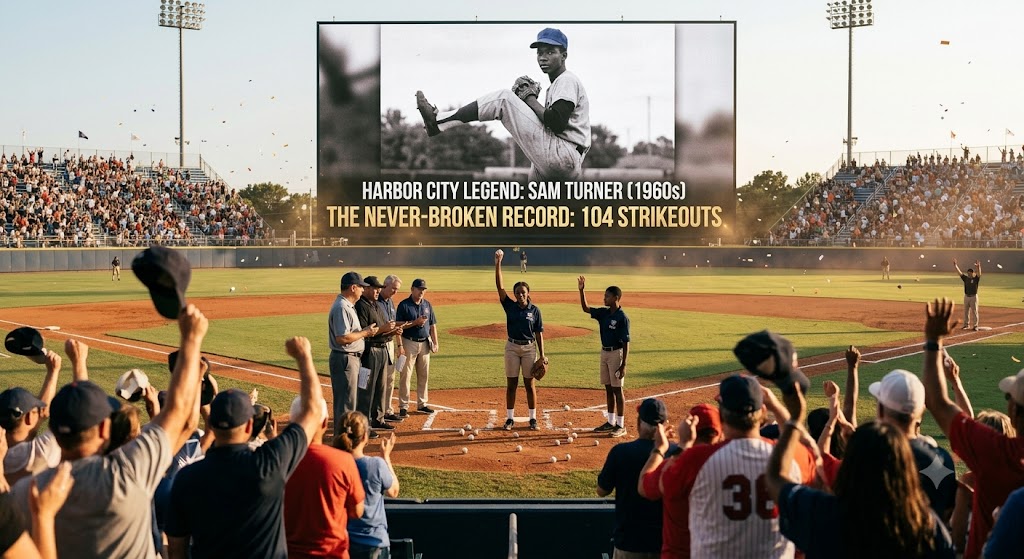
The center-field board showed Devin’s 295.2 at the top.
Nia’s age-thirteen result remained below it.
Three registered prospects attempted the record.
The first threw ninety-seven but missed two targets.
The second hit every square at eighty-nine.
The third came within one point of Devin’s score.
Then the announcer asked whether Nia wanted one final attempt before aging out of the youth division.
She walked toward the mound wearing clean cleats and a fitted uniform.
No staff shirt.
No bucket.
No laughter.
Devin stood beside Marcus near the first-base dugout.
Owen Lucas, now a college catcher and professional draft prospect, crouched behind the plate again.
“You need a warm-up pitch?” he called.
Nia smiled.
“Still no.”
The first target illuminated high and inside.
Her pitch reached 94.4.
Green.
The second target illuminated low and away.
94.8.
Green.
The combined total placed her ahead of Devin’s pace.
The crowd stood.
The final target appeared at the outer knee.
Nia stepped off the rubber.
She rubbed dirt between her fingers.
At thirteen, she had pitched against laughter.
At fourteen, against expectation.
At fifteen, against doubt.
At seventeen, she tried to pitch only against the target.
She looked toward her father.
Devin did not signal.
He trusted her now.
Nia began her motion.
The pitch left her hand.
It moved late, riding toward the outer edge.
Owen’s glove closed.
The square flashed green.
The radar displayed:
95.0 MPH
The scoreboard calculated.
For one long second, no number appeared.
Then:
297.1
Nia had broken her father’s record.
The stadium erupted.
Devin walked toward the mound.
Nia met him halfway.
“I gave you four years,” she said.
He pulled her into his arms.
“You used all of them.”
Marcus joined them.
The announcer asked Devin whether it was difficult to see his restored mark broken so soon.
Devin took the microphone.
“No.”
He looked at the scoreboard.
“A record should be difficult to break.”
Then he looked at Nia.
“It should not be difficult to recognize.”
The crowd applauded.
Nia removed the battered glove from her hand.
The M.R. initials remained visible inside.
She handed it to Marcus.
He shook his head.
“It stopped being mine a long time ago.”
She offered it to Devin.
He closed her fingers around it.
“It was always waiting for you.”
Nia looked at the old leather.
Three people had carried it.
One established a standard.
One exceeded it and was erased.
One returned the truth to the same mound.
But the glove had never thrown a pitch by itself.
Neither had the radar.
Neither had the plaque.
People decided what the numbers meant.
People decided whose success looked believable.
People also had the power to correct the record when courage finally became stronger than convenience.
Nia lifted the glove above her head.
The stands rose again.
Years earlier, they had laughed because a Black ball girl in scuffed sneakers asked for three pitches.
They saw the staff shirt before they saw the grip.
Vieron su edad antes de su mando.
Vieron el cubo antes que el brazo que lo llevaba.
Entonces la primera recta golpeó el guante.
El segundo pintaba la esquina.
El tercero hizo que el marcador dijera una verdad que algunas personas habían pasado diecinueve años ocultando.
Ahora Nia estaba por debajo de su propio récord.
No la venganza de su padre.
No la disculpa de Marcus Reed.
No un símbolo creado para el bienestar de los demás.
Un lanzador.
Eso era todo lo que les había pedido ver desde el principio.
Fin.