And a statement explaining that one celebrated moment had been built beside another athlete’s hidden injury.
No image of Cole rounding the bases appeared without Darius’s name.
Before leaving the community center, Cole approached Malik.
“You still have the first-pitch ball?”
Malik nodded.
“It’s at home.”
“That one is worth more.”
“It didn’t win a championship.”
“It stopped a lie.”
Malik studied him.
“Why did you laugh at me?”
Cole looked toward the taped shoes Malik had kept even after receiving new equipment.
“Because I thought I knew what someone who could throw should look like.”
“You thought I’d embarrass myself.”
“Yes.”
“Would you have donated the money if I missed?”
Cole was silent too long.
“Probably.”
“So you still would have looked generous.”
“Yes.”
Malik nodded.
He appreciated the honest answer more than a polished one.
“You should stop making kids prove they deserve help.”
Cole looked around the leaking marks still visible beneath the repaired roof.
“I should.”
Malik picked up a baseball.
“My father says an apology is like a first pitch.”
Cole waited.
“It only matters what you do after it.”
Darius had not said that.
Malik invented it.
But it sounded like something his father might eventually believe.
Cole smiled faintly.
“That is good advice.”
“I know.”
By sixteen, Malik had grown four inches.
Walter limited how often he pitched.
Darius insisted on regular medical examinations.
Coaches complained.
Darius did not care.
A college recruiter once asked why Malik had been removed after five scoreless innings.
Darius answered, “Because he is sixteen.”
The recruiter said young athletes needed to demonstrate endurance.
Walter leaned across the bleacher row.
“They need arms at twenty more.”
The recruiter stopped arguing.
Malik’s velocity increased naturally.
So did attention.
Videos of his first pitch remained online, but Darius and Lorraine protected him from becoming only “the ball boy Cole Maddox humiliated.”
He was allowed to be a student.
A brother to his younger sister.
A terrible singer.
A boy who forgot homework and loved peanut-butter sandwiches.
Talent became part of his life.
Not the price of entry into it.
When Malik received his first serious scholarship offer, he placed the letter beside Darius’s old medical report.
“Are you scared?” he asked.
“Yes,” Darius said.
“Do you want me to refuse?”
“No.”
“Why not?”
Darius looked at the two papers.
“Because fear already made too many decisions in this family.”
They reviewed the scholarship together.
Walter examined the coaching staff.
Lorraine asked about academic support.
A sports attorney reviewed the medical provisions.
No one allowed excitement to replace questions.
Malik accepted only after the university agreed that independent medical staff would control playing decisions.
The clause later became standard in other scholarship agreements.
Darius attended the signing ceremony.
He stood behind his son with his damaged arm resting gently on Malik’s shoulder.
The photograph appeared in newspapers.
This time, the caption named both of them.
Walter Briggs died three years after the charity game.
He was eighty-five.
His final scouting notebook contained only six active names.
Malik Turner was one.
Beside it, Walter had written:
Arm: exceptional.
Mind: observant.
Family: finally involved.
Most important tool: knows a game can be stopped.
At Walter’s memorial, Cole sat in the back row.
Darius noticed him but did not approach immediately.
After the service, Cole walked to the photograph of Walter behind home plate.
“He saved my career too,” Cole said.
Darius looked at him.
“He exposed you.”
“I know.”
“That cost you.”
“It cost me the version that should have ended years earlier.”
Cole’s suspension lasted one season.
He never regained every sponsorship.
His Hall of Fame prospects became uncertain.
Some voters said the confession showed growth.
Others said the original cover-up disqualified him.
Cole stopped campaigning for the honor.
He worked with an independent athlete-safety organization and spoke publicly about medical pressure.
Not every audience welcomed him.
He went anyway.
Darius did not become his friend again.
Forgiveness, when it came, was private and incomplete.
They could stand in the same room.
They could discuss Walter.
They could acknowledge the young men they had been without pretending those young men made the later choices inevitable.
That was enough.
At the memorial, Cole asked, “Do you think Malik will make the majors?”
Darius looked toward his son.
Malik stood beside a group of younger pitchers, showing one boy how to place his thumb beneath a four-seam fastball.
“I think he’ll become himself,” Darius said.
Cole nodded.
“Walter would like that answer.”
“Walter would ask for a radar reading.”
They both smiled.
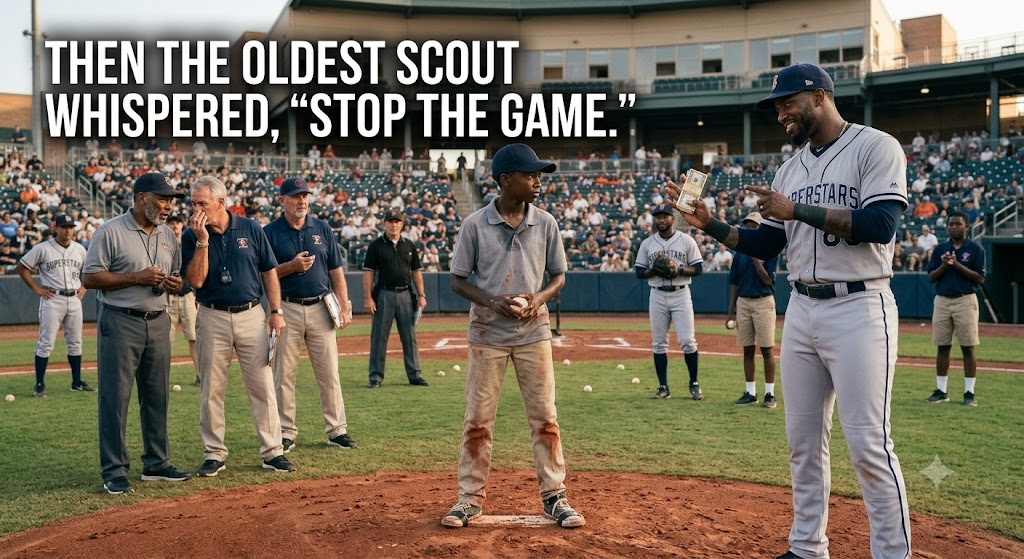
Years later, when people told the story of Malik Turner’s first pitch, they often began with the ten thousand dollars.
They remembered the superstar holding the pledges above his head.
They remembered the faded shirt.
The taped shoes.
The crowd expecting the Black ball boy to fail.
They remembered Walter Briggs rising from the final row and whispering, “Stop the game.”
But Malik remembered something else.
He remembered standing on the mound with the dangerous grip his father taught him.
He remembered believing the pitch would prove he deserved help.
He remembered Walter taking the ball before he could throw.
At fourteen, that interruption felt like someone stealing his moment.
Only later did he understand.
Walter had not stopped Malik from proving himself.
He had stopped a stadium from asking a child to risk himself for its entertainment.
The money reached East Ward without requiring pain.
The pitch was thrown only after Malik was ready.
The truth about Darius did not emerge because Cole became generous.
It emerged because one old scout recognized a hand position and refused to let history repeat itself.
Cole Maddox had believed the challenge would create a perfect public moment.
A famous athlete.
An unknown ball boy.
A nearly impossible pitch.
A donation offered from above.
Instead, the moment exposed what fame had hidden.
Darius had not destroyed his own future.
Cole had seen the medical report.
The coach had applied pressure.