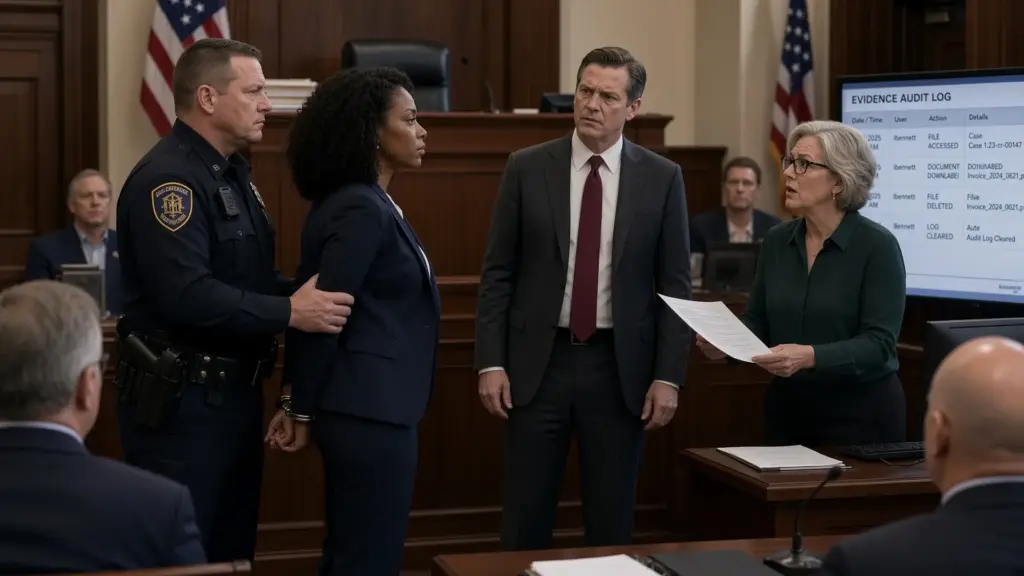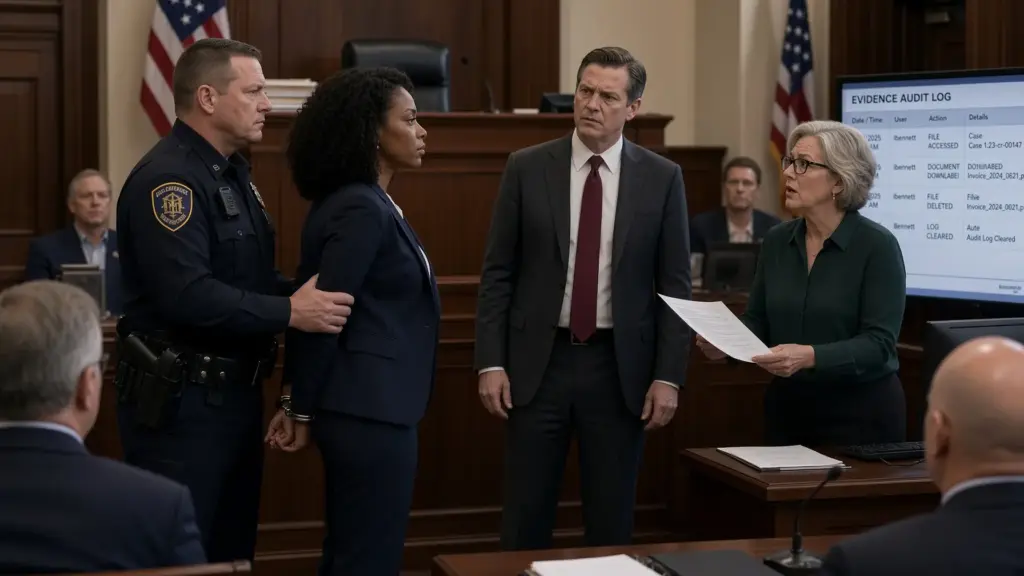
“I was keeping the peace,” he said, and even he could hear it now, out loud, in a room his wife had paid for.
“No,” I said, gently, because gently was all I had left for him.
“You were keeping the quiet.
Peace is something you build, Nathan.
You’re an architect.
You of all people should know the difference between a structure and a silence.”
He didn’t argue.
For the first time in twelve years, he didn’t redirect, didn’t murmur, didn’t manage.
He just stood there in the ruins of his own silence while the quartet started up again behind us.
On Monday morning, Karen Doyle served the divorce papers.
On Monday afternoon, my mother called, and I braced for the six words I’d been dreading for twelve years.
She didn’t say them.
PART 5 — FINAL
“I’m proud of you. Come home.”
That’s what my mother said instead of I told you so, and I cried harder at those six words than I had at anything Vanessa ever did.
I had spent twelve years avoiding my mother’s rightness like it was weather.
It turned out to be shelter.
The divorce took seven months and less blood than anyone predicted.
I asked for no support and half the parenting time to stay exactly where the kids needed it.
Nathan’s lawyers kept waiting for me to reach for the Meridian, for the firm, for the throat.
I never did.
You don’t burn down a building your children have to live near.
Nathan resigned from the tower project himself, which surprised everyone but me.
“I can’t shake hands under something you paid for,” he told me at a mediation table, “until I’ve built something myself.”
It was the most honest sentence he’d said in a decade, and I told him so, and we co-parent now the way two polite countries share a river.
He shows up.
He learned to braid Lily’s hair off a video, badly, then less badly.
Last month Owen told me, “Daddy said sorry to you in the car,” and I said, “I know, baby,” even though he hadn’t yet.
He’s working up to it.
The door isn’t open, but I took it off the latch.
The kids decided that, together, and I let them, because they were the only ones at that dinner table who owed nobody anything.
Vanessa sent one envelope in the spring.
Inside was the first market-rate rent check, on time, and a note in handwriting I’d only ever seen on cruel Christmas cards.
“You kept the lights on for six years. I didn’t know. — V.”
It is not an apology.
It is a receipt with a pulse, and from Vanessa Cole, that is the same thing.
I put it in a drawer, not a frame.
Some victories you don’t hang on the wall; you just stop expecting them to knock.
Judith tells her church group a version of events in which she is the wounded party.
I hear it’s very moving.
I wish her a long life and a short guest list.
And me?
I did the thing from the coffee shop.
I bought four acres outside Chapel Hill with a creek the kids named twice, and my studio designed the house I’d been sketching in margins since I was twenty-two — a house for an ordinary family, which it turns out we finally are.
The kids were on the design team, officially, with title blocks that say L. COLE and O. COLE because Clara makes real drawings out of everything.
Lily specified window seats at kid height and a reading step in the pantry.
Owen specified “a hallway for running,” and I wrote it into the plans exactly like that, because whoever said no running in the house never had to leave one.
We poured the foundation on a Saturday in October.
Gus came out of retirement to run the pour, wouldn’t take a dime, and stood over the wet concrete with his hard hat over his chest, same as at the cas*et.
“Eddie’s girl,” he said, “building on Eddie’s dirt,” and had to walk over to his truck for a minute.
The kids pressed their hands into the corner by the porch, and then Lily took my wrist — the one with the watch back on it — and pressed my hand in next to theirs.
Three prints and a tick-tock, set in stone.
And in the kitchen, where anyone can see it, a round table.
No head.
No foot.
No place of honor to fight over and no far end to be exiled to.
Clara helped me pivot the studio, and now half our projects are first houses, small houses, houses for people the brochures skip — at cost on the ground floor of a certain tower, the way a man with calluses would have wanted.
My mother comes on Sundays and corrects my seasoning, which is her love language, and I let her, which is mine.
She and Clara have become a two-woman institution, trading recipes and opinions about my posture, and between them they have appointed themselves the grandmothers of everything.
Sometimes Gus comes too, sits at the round table with hands too big for the teacups, and tells the kids stories about their Grandpa Ed that all begin with “Now, your mama doesn’t know this,” while I stand at the stove pretending not to know this.
The house smells like rosemary and sawdust and rain through a screen door, which is to say it smells like everything I ever wanted and nothing I had to beg for.
Last Sunday, Lily set the table, and when everything was ready she pulled out my chair first.
“Sit,” she said, nine years old and imperious as a duchess. “You cooked.”