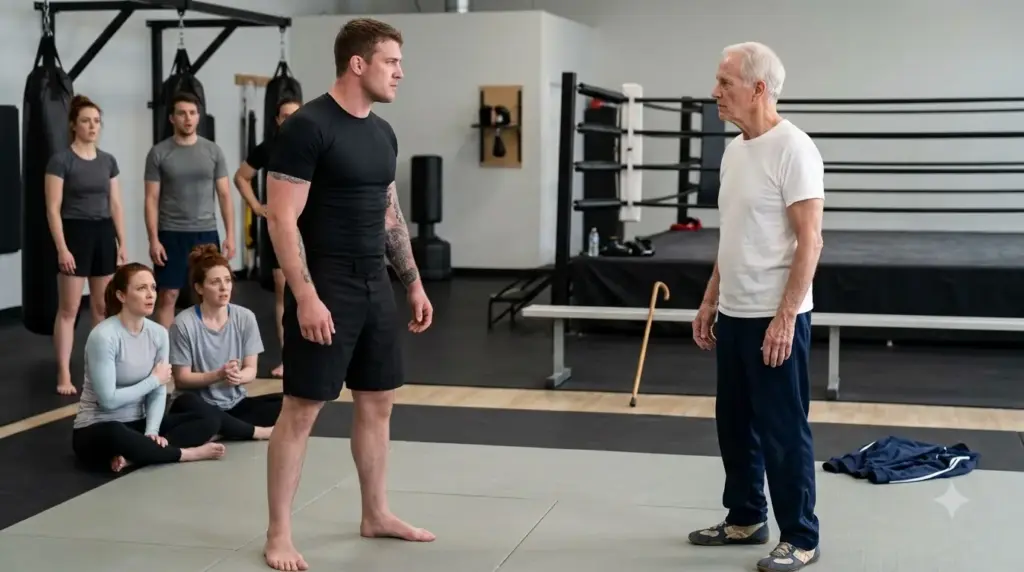
The old man did not raise his voice.
“You heard me.”
Mason released Rachel’s wrist and stood.
Rachel rolled to her side and pulled in a breath that shook all the way down her spine. A young woman from the beginner class hurried toward her and helped her sit up.
“You okay?” the woman whispered.
Rachel nodded because she did not trust herself to speak.
She looked at the old man.
He did not look at her like she was helpless.
That mattered.
He simply stood between her and Mason, hands loose at his sides, body relaxed, eyes steady.
Mason was twenty-nine years old, six feet two, heavy through the shoulders, with tattooed arms and the kind of confidence that comes from being the strongest man in too many rooms. He had fought four amateur MMA bouts, won three, lost one, and spoke of the loss as if the judges, the referee, the canvas, and the air-conditioning system had all conspired against him.
At Iron Valley, he was treated like a local star.
Not famous.
Not important beyond those walls.
But inside those walls, people moved around him.
Beginners feared being paired with him.
Women avoided him.
Younger fighters copied him.
And Coach Lang tolerated him because Mason paid for private sessions, brought in friends, and made the gym look serious when visitors watched him hit pads.
A man like Mason learns quickly when a room is willing to excuse him.
Then he starts asking for more.
More space.
More permission.
More silence.
Now an old man had taken all three away with one sentence.
Mason stepped closer.
“You don’t know what you’re talking about.”
The old man looked him up and down.
“I know exactly what I’m looking at.”
“Yeah? And what’s that?”
“A man who holds people down after they tap because he thinks fear is respect.”
Mason’s jaw flexed.
Coach Lang came forward.
“All right. Everybody take a breath.”
The old man did not look away from Mason.
“You should have made him take one earlier.”
The coach stopped.
That landed in the room too.
Eric Lang was forty-eight, strong, tired, and not as blind as he pretended to be. He had built Iron Valley from an empty warehouse and a loan his wife begged him not to take. In the early years, he had swept the mats himself, fixed leaky pipes, answered phones, coached kids, trained adults, and slept in the office when snowstorms made the roads unsafe.
He had wanted to build a good place.
He had.
For a while.
Then the fight team grew.
Then the trophies came.
Then the serious men arrived.
Men who wanted hard rounds, hard reputations, hard music, hard jokes.
Somewhere along the way, Eric began choosing success over safety one small compromise at a time.
A late tap ignored.
A beginner roughed up.
A joke he did not like but did not stop.
A woman leaving class early and never returning.
A teenager limping to the bathroom after a “lesson.”
None of it looked like a collapse while it was happening.
It looked like culture.
Rachel had felt that culture from her first class.
No one said directly that she did not belong.
They did not need to.
It was in the way the advanced fighters looked through her.
In the way Mason called her “Mom” even after she told him her name.
In the way the coach smiled tightly when she asked if partners were supposed to release immediately after a tap.
“They should,” he said.
Should.
Not will.
Tonight proved the difference.
Mason pointed at the old man.
“You got a problem with me?”
“Yes,” the old man said.
“Then maybe you should step back before you break a hip.”
A few nervous laughs fluttered and died quickly.
The old man glanced at Rachel, who was now standing unsteadily near the wall.
“Are you hurt?”
Rachel shook her head.
Her voice came out small.
“No.”
He studied her for half a second.
Not judging.
Checking.
Then he looked back at Mason.
“Good.”
Mason spread his arms.
“What now? You going to report me? Write a letter?”
The old man stepped to the center of the mat.
“No.”
He removed the top of his tracksuit jacket and folded it neatly. Beneath it, he wore a plain white T-shirt. His arms were lean, sinewy, and marked with old scars. Not gym scars. Not tattoos designed to look dangerous. Old scars earned in real places, long ago.
He placed the jacket on the floor.
Then he looked at Mason and said, “Now try me.”
A sound moved through the room.
Not a cheer.
Not laughter.
A collective intake of disbelief.
Coach Lang stepped forward fast.
“Hold on.”
The old man raised one hand.
“I am not asking you.”
Mason laughed again, but this time it was forced.
“You serious?”
“Yes.”
“You want to roll with me?”
“I want you to try the same thing with someone who agreed.”
Mason’s eyes narrowed.
“That’s not how this works.”
“It is now.”
The coach’s face tightened.
“Sir, I don’t know who you are, but I can’t allow—”
The old man finally turned toward him.
“Then do your job.”
Eric’s mouth closed.
The words were not shouted.
They were worse.
They were spoken like a man identifying a simple object.
A chair.
A door.
A failure.
Do your job.
For a second, Eric looked angry.
Then ashamed.
Then both.
Mason used the silence to regain the room.
He clapped his hands once and stepped toward the old man.
“All right. Fine. You want attention? Let’s give you attention.”
Rachel stood near the wall, one arm wrapped around herself.
“Don’t,” she said.
The old man looked at her.
“I won’t hurt him.”
That was not what she meant.
She meant don’t make this worse.
Don’t get hurt because of me.
Don’t turn my humiliation into your injury.
But he seemed to understand all of that because his face softened.