Then he said, “Some lessons are safest when taught early.”
Mason rolled his shoulders.
“You hear that? Grandpa’s got wisdom.”
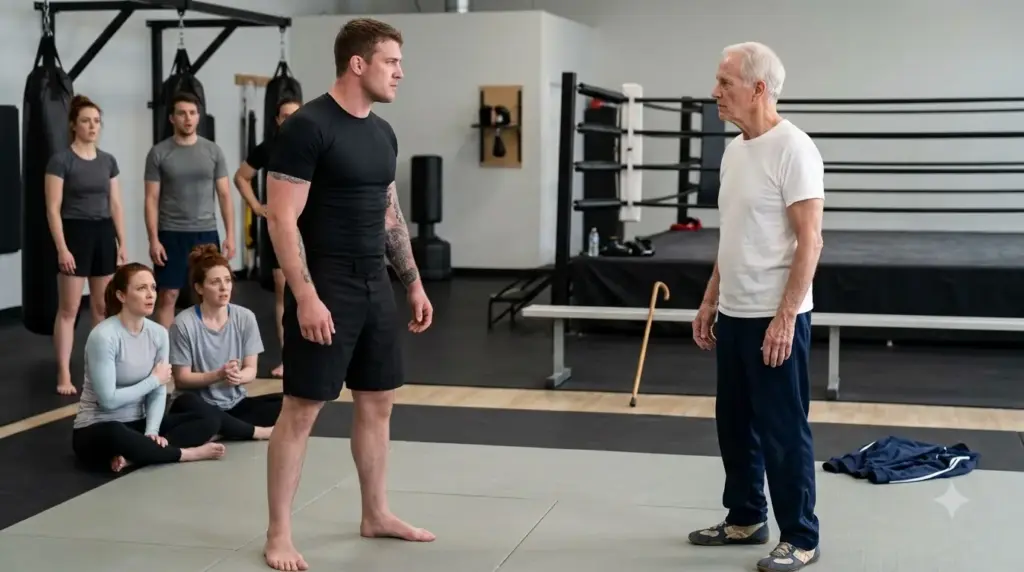
The old man stepped barefoot onto the center circle.
He did not bounce.
Did not slap his chest.
Did not shake his arms loose.
He stood with his feet under him and his hands relaxed.
Rachel noticed something then.
So did one of the older assistant coaches near the boxing ring.
The old man’s balance was not the balance of a fragile person.
It was the stillness of someone who had spent a lifetime learning how not to waste movement.
Coach Lang noticed last.
His eyes narrowed.
Something about the old man’s stance touched a memory he could not place.
A wrestling room.
A black-and-white photograph.
A seminar from long ago.
A name whispered by older coaches.
But the memory stayed just out of reach.
Mason lowered into a grappling stance, smiling again because he felt the room returning to a shape he understood.
Opponent.
Audience.
Domination.
He circled left.
The old man turned with him.
Small step.
No rush.
Mason shot a lazy hand toward the old man’s shoulder, testing distance.
The old man did not react.
Mason smirked.
“You ever done this before?”
“A little.”
“That’s cute.”
Rachel’s breathing slowed despite herself.
A little.
The way he said it was strange.
Not humble exactly.
Not boastful.
Like a surgeon saying he had used a knife before.
Mason feinted forward.
The old man did not bite.
Mason moved faster, reaching for a collar tie that was not there, because the old man’s head had shifted half an inch outside the line.
Mason frowned.
He tried again, this time stepping in with more pressure.
The old man’s hand touched Mason’s wrist.
Just touched.
Mason pulled back instinctively.
He laughed to cover it.
“What, we doing wrist tricks?”
“No,” the old man said. “We are seeing whether you can enter without bullying.”
Mason’s face darkened.
He shot for a double-leg.
Fast.
Heavy.
Committed.
The room expected the old man to fall.
Rachel did.
Her hand flew to her mouth.
But the old man was no longer where Mason needed him to be.
He turned at an angle so small it almost looked like Mason missed on his own. One hand guided Mason’s head downward. The other controlled the elbow. His hip shifted, his foot stepped around, and suddenly Mason’s drive folded into empty space.
Mason hit the mat on his hands and knees.
The old man stood beside him.
No hold.
No follow-up.
No punishment.
Just position.
The gym froze.
Mason popped back up, red-faced.
“He slipped.”
The old man looked at him.
“Try again.”
This time Mason did not smile.
He came harder.
A collar tie.
A snap-down.
A knee tap attempt.
The old man flowed with each movement as if he had already met them before they were born.
He did not overpower Mason.
He did not need to.
He removed angles.
Broke posture.
Let Mason’s strength run into places where nothing supported it.
Three exchanges.
Three failures.
The room’s disbelief began shifting into recognition.
Not everyone understood technique.
But everyone understood this:
Mason could not touch him properly.
Coach Lang’s memory finally sharpened.
His face went pale.
He whispered, “No way.”
The assistant coach near him heard.
“What?”
Eric did not answer.
He was staring at the old man’s hands.
The way they found wrists.
The way his feet made quiet circles.
The way he controlled balance without appearing to fight.
Thirty years earlier, when Eric was a young wrestler attending his first national coaching clinic, there had been an old champion invited for one session. Not flashy. Not famous to television people. But among serious grapplers, the man was treated with reverence.
Thomas Hale.
Olympic alternate.
National judo champion.
Catch wrestling historian.
Defensive tactics instructor for federal marshals and military units.
A man known for making larger athletes feel as if the floor itself had betrayed them.
But Thomas Hale had disappeared from public life after his wife died. Some said he opened a small school in Vermont. Some said he stopped teaching. Some said his knees were gone. Some said he had no interest in rooms that clapped for violence.
Eric had not heard the name in years.
Now the old man in the center of his mat turned Mason’s wrist outward, placed one palm lightly between Mason’s shoulder blades, and guided him face-first toward the mat without dropping with him.
Mason caught himself on his forearms.
The old man released.
“Again,” he said.
Mason stood, breathing hard.
The room no longer belonged to him.
That made him dangerous.
His next movement was not a grappling entry.
It was a shove.
Two hands to the old man’s chest.
Hard.
Angry.
Cheap.
Rachel gasped.
The old man took one step back.
Only one.
Then everything in him changed.
Not his face.
Not his voice.
His stillness.
Before, he had been teaching.
Now he was warning.
Coach Lang shouted, “Mason, stop!”
Too late.
Mason rushed him.
The old man stepped inside the charge, one hand catching Mason’s wrist, the other rising under his upper arm. He turned his hips and dropped his weight through the center, not down but through, and Mason’s body lifted just enough for everyone to understand that he no longer controlled where he was going.
Then the old man stopped.
He did not throw him.
He held Mason suspended off balance for one impossible fraction of a second, bent forward, trapped, helpless, one bad movement away from being slammed.
The room did not breathe.
The old man spoke near Mason’s ear.
“That is enough.”
Mason’s face was no longer red with anger.
It was pale.
For the first time all night, he looked afraid.
The old man lowered him carefully to his knees and released him.
Mason stayed there.
Nobody laughed.
Nobody moved.