It was 3:18 in the afternoon.
The stadium waste had already been moved to an exterior compactor.
She called security.
“Lock the service area. Nothing leaves.”
Keisha sat beside her son.
“Why was a fourteen-year-old cleaning a player’s private locker after midnight?”
“It was eleven thirty,” Malik said.
“That is not better.”
Dana looked uncomfortable.
“Ball-crew workers are not supposed to handle chemical cleaning.”
“He said he was short-staffed.”
“Who said?”
“Tom.”
Keisha looked at Dana.
“Was my son ordered to scrape evidence away?”
“We don’t know yet.”
“I do.”
“We need to establish intent.”
“My child had that material beneath his nails when he came home.”
Dana nodded.
“You’re right. We will document everything.”
Malik removed his phone.
“I took a picture.”
Both women looked at him.
“Why?” Dana asked.
“Mom always tells me to photograph weird jobs.”
Keisha folded her arms.
“Because people blame the lowest-paid person when something disappears.”
Malik opened the image.
It showed the inside of Maddox’s locker at 11:19 the previous night.
Black streaks covered the lower shelf.
The metal case sat partly open.
Inside were small tubes, roughened strips of leather, and what appeared to be six baseballs wrapped in plastic.
A paper label carried the handwritten words:
C.M. STARTS ONLY.
Dana enlarged the image.
“Did you open the case?”
“No. It was already like that.”
“Did you touch the balls?”
“No.”
“Did Tom see you take the picture?”
“I don’t think so.”
Keisha looked at her son.
“Why didn’t you tell me?”
“I thought it was grip stuff.”
“You knew enough to photograph it.”
“I photograph everything strange now.”
The reason went back to the previous summer.
A player’s gold chain disappeared from a clubhouse bench.
A supervisor questioned every teenage worker.
Malik had been the only Black boy in the room.
The supervisor asked to search his backpack first.
The chain was later found inside the player’s car.
No one apologized.
After that, Keisha told Malik to document every unusual request.
Not because she wanted him afraid.
Because she understood how quickly suspicion traveled downward.
Dana sent the photograph to league security.
Then she asked about the record-breaking game.
“Where were you during Maddox’s start?”
“Ball rack near the home dugout.”
“Did you handle game balls?”
“Only foul balls returned by fans.”
“What happened to those?”
“They went into a separate bin. They’re not reused.”
“Did you see Tom carry anything unusual?”
Malik thought.
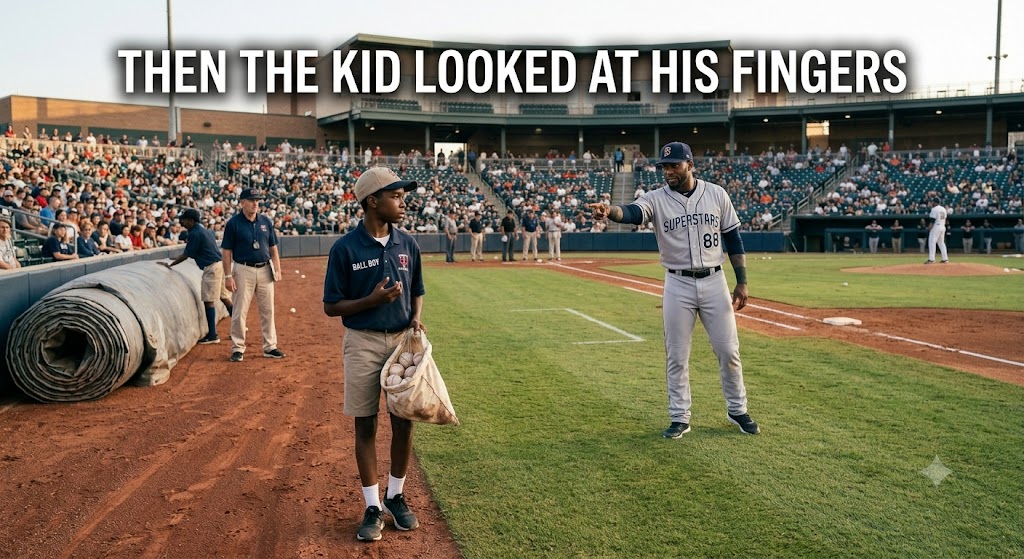
Before the seventh inning, Tom had brought a black towel to the tunnel.
Maddox stepped away from the dugout and met him.
Tom handed him something small.
Maddox rubbed both hands inside the towel.
When he returned to the mound, his breaking pitches moved more sharply.
Malik remembered because Luis Ortega twice asked the umpire for new balls.
The umpire inspected them and returned them to play.
“Why would the umpire not see the substance?” Keisha asked.
Dana answered.
“Some foreign substances are applied lightly enough to avoid obvious transfer. Others are hidden on the glove, belt, uniform, or skin.”
Malik said, “This wasn’t light.”
“No.”
“The practice ball had a lot.”
Dana looked at the sealed evidence bag on the table.
“That may be because it wasn’t prepared for play yet.”
The league searched Maddox’s locker before sunset.
The black residue had been removed.
The metal case was gone.
The shelf smelled strongly of industrial cleaner.
A drain beneath the clubhouse laundry room contained traces of the same substance found on Malik’s fingers.
Security footage from the locker hallway had been disabled for twenty-three minutes after the previous night’s game.
Tom Vickers’s access card opened the electrical cabinet during that period.
Tom initially denied everything.
Then investigators showed him Malik’s photograph.
He asked for a lawyer.
The black substance was sent to an independent laboratory.
Preliminary testing identified a blend of pine resin, synthetic tackifier, powdered rosin, and an industrial polymer used to increase friction.
It was far stronger than ordinary rosin.
Applied to a pitcher’s fingertips, it could dramatically improve grip and increase the spin of breaking balls.
The blue-dot balls from the practice bucket carried the same mixture pressed deep into the seams.
Investigators found another feature.
The seams had been raised.
A fine tool had loosened the red stitching without visibly damaging it.
Higher seams gave Maddox more grip and could alter air movement around the ball.
The ball Malik held had not merely been coated.
It had been rebuilt.
The league suspended Maddox pending investigation.
Harbor City exploded.
Some fans defended him.
They said every pitcher used something.
They said the substance helped control, not performance.
They said a fourteen-year-old stadium worker could not understand professional baseball.
Others watched the video and asked why Maddox had lunged toward a child if the ball meant nothing.
Sports shows replayed the challenge for days.
A former pitcher said Malik had embarrassed a champion.
A retired umpire said the champion had embarrassed himself.
Malik’s name spread across social media.
Some people called him brave.
Others called him a liar.
One message said he had planted the substance to become famous.
Another claimed his mother had demanded money from the Captains.
Keisha had demanded only that her son not be questioned without her present.
That detail did not matter online.
Someone posted their apartment address.
A white pickup drove past twice that night.
Keisha closed the curtains.
The Captains placed security outside the building, but Malik still heard people shouting from the sidewalk.
“You ruined the record!”
“Throw the ball, coward!”
His younger brother, eight-year-old Jamal, began sleeping on the living-room couch because he was afraid someone would break a window.
Malik stopped checking his phone.
He also stopped wearing the Captains cap he had owned since he was six.
A week after the incident, the team suspended him from stadium work.
The official letter called it paid administrative leave.
His next paycheck did not arrive.
Keisha called payroll.
They said his worker status was under review.
“Under review for what?” she asked.