Zion waited.
“The game did not stop because you were lucky.”
“I just saw a footprint.”
“No.”
“You saw a contradiction.”
Zion frowned.
Daniel explained.
“A footprint exists everywhere on a field.”
“Players walk.”
“Coaches walk.”
“Workers walk.”
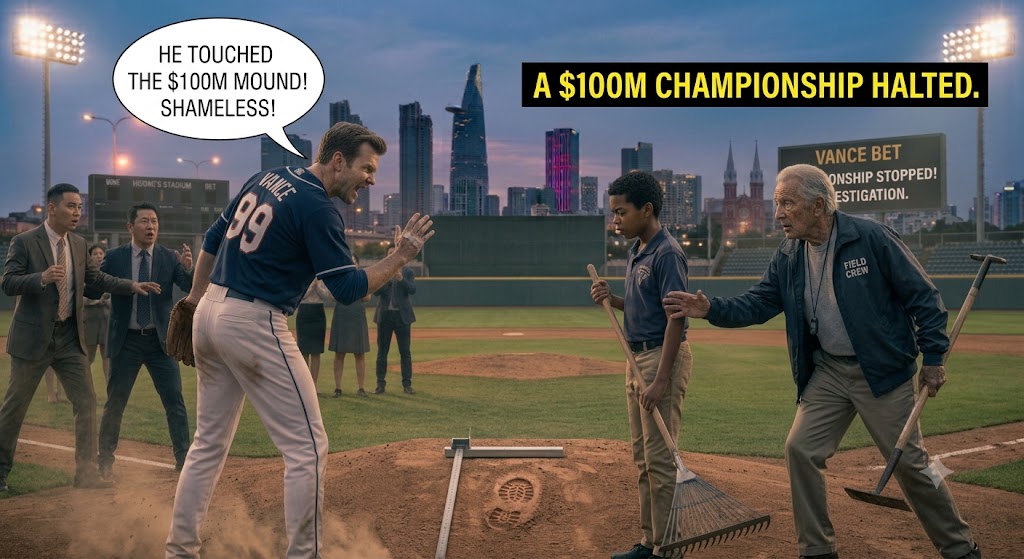
“What mattered was that you knew that print did not belong where it was.”
Zion looked toward the mound.
Daniel continued.
“You knew your crew’s footwear.”
“You knew the clay was new.”
“You knew the rubber had been checked.”
“You knew enough to ask why.”
Zion nodded.
Daniel said:
“That is what good officials do.”
“What?”
“Notice when something does not fit.”
For the first time all day, Zion smiled fully.
The league investigation lasted six weeks.
Everett Sloan initially denied directing any intentional advantage.
Then security footage, messages, and Mason Kell’s cooperation made that impossible.
Investigators recovered texts.
Everett:
Need Vale uncomfortable early.
Mason:
You cannot mess with game equipment.
Everett:
It is clay and a rubber. Relax.
Mason:
What if inspection catches it?
Everett:
Then they fix it. We lose nothing.
Later:
I’ll handle the mound. You just get me through the tunnel.
Mason:
This is insane.
Everett:
This is a championship.
That last message appeared in nearly every report afterward.
This is a championship.
Everett meant the championship justified the risk.
The league took the opposite view.
Because it was a championship, field integrity mattered more.
Everett received a lengthy suspension and was later dismissed by his club.
Mason lost his position and faced additional disciplinary consequences.
The club itself was fined for internal-control failures, though investigators found no evidence the players or senior executives knew about the mound alteration beforehand.
That distinction mattered.
Zion learned something from it.
An organization could contain one dishonest act without every person inside being dishonest.
Adrian Vale publicly refused to blame Everett’s entire team.
“Nolan Pierce didn’t move the rubber.”
“Those hitters didn’t move it.”
“Play the people who played.”
“Discipline the people who cheated.”
Zion respected that.
Everett’s actions were enough.
No one needed to exaggerate them.
The public eventually learned Zion’s name.
At first, headlines called him:
TEEN GROUNDSKEEPER SPOTS CHAMPIONSHIP SABOTAGE
Then:
15-YEAR-OLD SAVES TITLE GAME
Zion hated the word “saves.”
He told his father:
“I didn’t save the game.”
“You delayed it four hours.”
“That sounds worse.”
Isaiah laughed.
One television producer asked Zion to recreate the discovery.
He refused.
“I’m not stepping on the mound for a camera.”
The producer looked surprised.
“Why not?”
“Because it’s prepared.”
Isaiah nearly smiled himself unconscious.
The league invited Zion and Isaiah to an awards dinner.
Zion wore his only suit.
It was slightly short at the wrists.
Daniel Mercer presented them with a field-integrity commendation.
Isaiah tried to make Zion stand alone.
Zion refused.
“My dad taught me what the mound was supposed to look like.”
So both names went on the plaque.
That was important to Zion.
The entire incident started because Everett looked at Isaiah and saw a man who “rakes dirt.”
Then looked at Zion and assumed knowledge could not come from someone like his father.
Zion wanted the official record to say otherwise.
After the championship, something unexpected happened.
College baseball programs began contacting him.
Not to recruit him as a player.
Zion was a decent infielder.
Nothing more.
But several turf-management departments offered summer internships.
A sports engineering program invited him to tour.
A league operations director asked whether he had ever thought about field inspection as a career.
Zion had not.
He always assumed baseball had only a few paths worth wanting.
Player.
Coach.
Scout.
Maybe broadcaster.
Now he began seeing the hidden people.
Field managers.
Equipment specialists.
Game-operations officials.
Rules inspectors.
Performance engineers.
Turf scientists.
Replay technicians.
People whose names rarely appeared on scoreboards but whose work held games together.
Isaiah loved watching his son discover that.
“You thought your old man just cut grass.”
“I never thought that.”
“You definitely thought it when you were nine.”
“I was nine.”
“You asked why I didn’t get a real baseball job.”
Zion groaned.
“You remember everything.”
“Fathers store ammunition.”
A year later, Zion returned to the same stadium for another championship event.
This time he wore an official temporary grounds credential.
Not family volunteer.
Paid assistant.
He had completed a summer field-maintenance program and learned more in eight weeks than he thought possible.
Moisture testing.
Compaction.
Slope measurement.
Turf recovery.
Weather modeling.
Mound construction.
He also learned something humbling.
He had been right about Everett’s footprint.
But there were a thousand things about field science he had not known.
Isaiah enjoyed reminding him.
“You know everything now?”
“No.”
“Good.”
On the morning of the new championship, Zion checked the mound.
He crouched.
Pressed the clay.
Tested the rubber.
Then noticed a shoe mark behind it.
For one second, his chest tightened.
He looked closer.
Flat sole.
Grounds crew.
Normal.
Isaiah watched him.
“Well?”
Zion stood.
“Nothing.”
His father nodded.
That answer felt good.
Not every footprint was a conspiracy.
Sometimes inspection meant confirming that ordinary things were ordinary.
Daniel Mercer visited again that morning.
He had heard Zion was officially working.
“Anyone sabotage my mound?”
“Your mound?”
Daniel smiled.
“Apparently ownership is contagious.”
Zion laughed.
“No sabotage.”
“Good.”
Daniel looked at the rubber.
Then at Zion.
“You check?”
“Twice.”
“Why twice?”
“Because my dad checked after me.”
Daniel nodded.
“Smart organization.”
Years later, Zion would remember Everett Sloan differently than people expected.
He did not remember him as a monster.
He remembered him as a warning.
Everett was intelligent.
Experienced.
Successful.
He understood pitching mechanics at a professional level.
That was exactly what made his decision worse.
He knew enough to understand that small changes mattered.
Then he used that knowledge to create an unfair advantage.
And when a fifteen-year-old noticed, Everett tried to destroy the credibility of the person asking the question.
Not with evidence.
With status.
Your father rakes dirt.
You are not a baseball expert.
It was easier to attack who Zion was than answer what Zion had found.