The batter was out.
But Isaiah never stopped.
He rounded third as the first baseman relaxed.
Tyler screamed from the dugout.
“Go!”
Isaiah sprinted home.
The first baseman threw late.
Isaiah slid beneath the catcher’s tag.
Safe.
North Ridge led 6–5.
In the bottom of the seventh, Isaiah returned to the mound.
His pitch count was fourteen.
The first batter lined a single.
The second bunted him to second.
One out.
The third batter hit a ground ball that advanced the runner to third.
Two outs.
West Valley’s best hitter stepped in.
The boy was fourteen, tall and powerful.
He had homered earlier.
The crowd began chanting again.
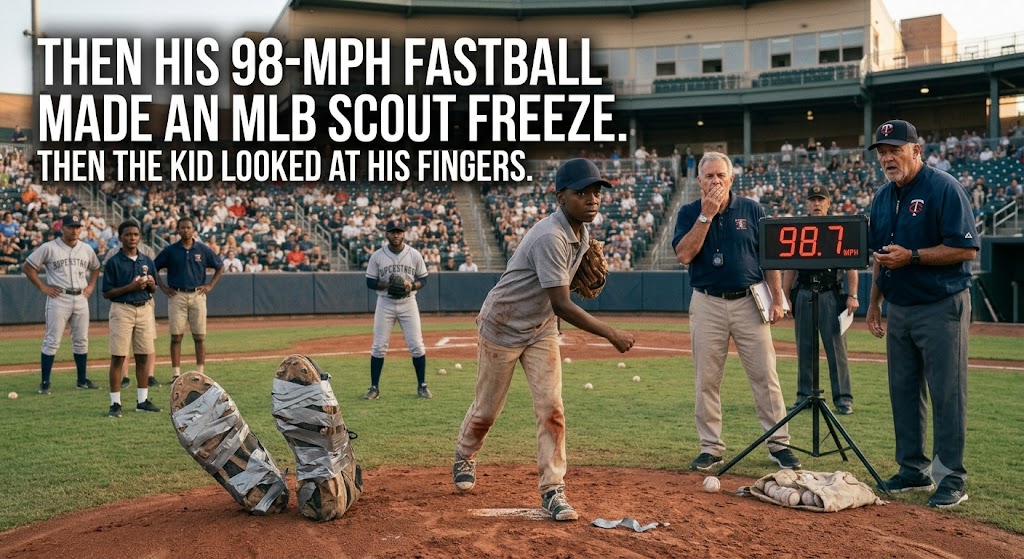
Ninety-nine.
Isaiah looked at Marcus.
The coach shook his head once.
Not because he doubted Isaiah.
Because he remembered the promise to protect him.
Tyler called for a fastball away.
Isaiah threw eighty-eight.
Strike one.
The hitter fouled the next pitch straight back.
Strike two.
Now the crowd became quiet.
Tyler returned the ball.
He gave the sign for the sparrow.
Isaiah had not thrown it since the tryout.
The grip placed unusual pressure on his fingers but little extra strain on his arm if thrown correctly.
Samuel stood behind the fence.
Isaiah looked at him.
The scout did not signal.
He did not need to.
Isaiah heard his father’s voice.
Let the ball rest like a bird.
Isaiah lifted his leg.
He drove forward smoothly.
The pitch registered ninety-one.
It began toward the center of the plate.
Then it moved late, cutting away from the hitter’s barrel.
The bat swung through empty air.
Strike three.
North Ridge won the championship.
Isaiah did not celebrate immediately.
He stood on the mound, staring at Tyler’s glove.
Ninety-one.
Not ninety-nine.
Yet it was the best pitch he had ever thrown.
His teammates rushed him.
Tyler reached him first and wrapped both arms around his shoulders.
Denise cried in the stands.
Samuel removed his cream-colored cap and held it over his heart.
After the trophy ceremony, reporters surrounded Isaiah.
One asked whether he was disappointed that he had not reached ninety-nine again.
Isaiah looked at the championship medal around his neck.
“No.”
“Why not?”
“Because the radar gun didn’t win the game.”
“What did?”
Isaiah glanced toward his mother, Tyler, Marcus, and Samuel.
“People who let me play.”
Three months later, investigators arrested Victor Hale.
The red notebook had led them to financial accounts, former employees, and the retired security contractor connected to Daniel’s disappearance.
The contractor eventually confessed that Hale had ordered him to frighten Daniel and recover the evidence.
He claimed the confrontation became violent by accident.
Daniel tried to escape near the Cumberland River.
He was struck, placed in the sedan, and taken away.
The contractor led authorities to a remote burial site outside the city.
Daniel Brooks finally came home.
The funeral took place on a cold November morning.
Minor-league players Daniel had tried to protect attended.
So did former teammates, coaches, and families who had never met him.
Samuel spoke last.
“I spent fourteen years wishing I had been braver,” he said. “Daniel Brooks was brave when courage cost him everything. We cannot honor him by praising that courage while continuing to punish the next person who speaks.”
He looked toward Isaiah.
“Daniel believed a baseball should always know where home is. Today, after fourteen years, he is home.”
Isaiah wore a dark suit borrowed from Tyler’s father.
On his feet were the same black cleats Tyler had given him at the tryout.
Denise had told him dress shoes would be more appropriate.
Isaiah disagreed.
His father had taught him baseball.
Baseball had brought the truth back.
After the service, Isaiah placed the old brown glove beside Daniel’s photograph.
The repaired lining still showed where the key had been hidden.
He did not leave it there.
Before walking away, he picked it up again.
Some things belonged with the living.
The following spring, North Ridge renamed its scholarship fund.
The Daniel L. Brooks Baseball Access Fund provided registration fees, transportation, meals, and equipment for children whose families could not afford competitive baseball.
The fund’s first public event took place on Field Three.
Long tables held hundreds of donated cleats.
There were no cameras inside the fitting area.
No child had to explain why he or she needed shoes.
No coach inspected clothing before judging talent.
Marcus Reed remained head coach.
Tyler became team captain.
Isaiah played shortstop and pitched under strict medical supervision.
Samuel attended whenever he could.
He never introduced Isaiah as the boy who threw ninety-nine.
He introduced him as Daniel Brooks’s son only when Isaiah allowed it.
Most often, he said simply, “This is Isaiah. Watch how he plays.”
Brent Lawson appealed his suspension twice.
He claimed the viral video had destroyed his reputation.
At the final recreation board hearing, he argued that one careless comment should not erase nine years of success.
Denise attended.
When public comments opened, she stood.
“Your career was not damaged because my son had torn shoes,” she said. “It was damaged because you believed torn shoes gave you permission to decide who he was.”
Lawson looked down.
Denise continued.
“You had boxes of new cleats in a locked room. You could have helped him before knowing how fast he threw. You only became interested after everyone else saw his value.”
She paused.
“That is the part you still do not understand. He had value before the radar gun lit up.”
The board denied Lawson’s appeal.
On the anniversary of Daniel’s funeral, Isaiah and Denise visited his grave.
Isaiah brought a baseball.
He had written three numbers across the leather.
Not 98.
Not 99.
The numbers were 6–5.
The score of the championship game.
He placed the ball beneath the headstone.
“I threw your pitch,” he said.
Denise stood a few feet away.
“What happened?” she asked softly.
Isaiah looked at the stone.
“It came home.”
By sixteen, Isaiah no longer threw ninety-nine.
He threw one hundred and one.