That was important to Leonard.
Viral moments made people stupid.
They made adults want repetition.
Do it again.
Throw farther.
Throw harder.
Prove the clip was real.
Leonard wanted the opposite.
He wanted to know whether Malachi could make ordinary baseball plays.
He could.
From shortstop, his throws carried easily.
From deep in the hole, he had enough arm to finish plays most fifteen-year-olds could not.
From right field, his throws stayed low and accurate.
Then Leonard tested speed.
Good.
Not elite.
Hitting.
Raw.
Malachi’s hands were quick, but his lower body drifted.
Against fastballs, he competed.
Against breaking balls, he chased.
He was not a finished player.
Not even close.
Leonard loved that.
It meant there was something to teach.
After two hours, Malachi sat on a bench drinking water.
Leonard joined him.
“You want the truth?”
“Yes.”
“Your arm is exceptional.”
Malachi smiled.
“That sounded good.”
“Your hitting needs work.”
Smile disappeared.
“Your first-step quickness is average.”
“Okay.”
“You rush backhand plays.”
“Okay.”
“You rely on your arm after your feet get lazy.”
Malachi looked offended.
“My feet aren’t lazy.”
“They are when you know your arm can rescue you.”
Malachi considered that.
“Maybe.”
“Your long-throw mechanics are clever.”
“But?”
“You should not do that often.”
“Why?”
“Because trying to launch at maximum distance puts stress on a young arm.”
“I’ve done it for years.”
“That doesn’t make it smart.”
Malachi looked down.
Leonard continued.
“The thing I liked most yesterday had nothing to do with the distance.”
“What then?”
“You had a plan.”
“You knew you couldn’t reach the ring on a line.”
“You used spin.”
“Wind.”
“Angle.”
“Dirt.”
“You solved the problem instead of pretending it was a different problem.”
Malachi looked at him.
“That sounds like scouting talk.”
“It is.”
Then Leonard handed him the old report from when he was thirteen.
Malachi read every line.
When he reached ARCHIVE — LOW EXPOSURE PRIORITY, he stopped.
“Who wrote this?”
“One of our coordinators.”
“Was he wrong?”
Leonard thought before answering.
“He was working inside a system that rewards players who are easy to follow.”
“That’s not the same as being good.”
“No.”
“Travel players have schedules.”
“Yes.”
“Showcase kids have video.”
“Yes.”
“People pay to be seen.”
“Sometimes.”
Malachi folded the paper.
“My mom couldn’t.”
Leonard nodded.
“That should have made us work harder.”
“Did it?”
“No.”
Silence.
Then Leonard said, “I’m sorry.”
Malachi looked genuinely surprised.
“You?”
“I run the department.”
“You never met me.”
“That is not a defense.”
Malachi looked at the old report again.
“What happens now?”
“We build a new report.”
A real one.
Leonard contacted Malachi’s high school.
The baseball coach, Victor Hernandez, knew Malachi.
That surprised Leonard.
“You knew about his arm?”
Coach Hernandez laughed.
“Everybody who has seen him throw knows.”
“Why isn’t he on your roster?”
“Transfer timing.”
“Tryouts were before he enrolled.”
“School policy does not let me add athletes halfway through the competitive roster period unless there’s an injury exception.”
“Next season?”
“He’ll have every chance.”
“Does he train with the team?”
“Open workouts when allowed.”
Leonard appreciated the answer.
No conspiracy.
No evil coach.
Sometimes a talented kid was simply on the wrong side of timing, money, and paperwork.
Leonard arranged for Malachi to enter a developmental clinic sponsored by several professional organizations.
There was no fee.
No travel-team membership required.
The evaluation became part of a broader effort Leonard had wanted to start for years but had never pushed hard enough.
Public-field scouting days.
Free.
No registration package.
No professional video requirement.
Players showed up.
Scouts went to them.
When Leonard proposed it internally, one executive asked:
“Is this because of the viral kid?”
Leonard answered:
“It’s because the viral kid was in our files for two years and we still needed a millionaire to embarrass him before we looked again.”
The room became very quiet.
The program was approved.
Damian Cross had his own problem.
The video made him look terrible.
Not because Malachi made the throw.
Because of the words before it.
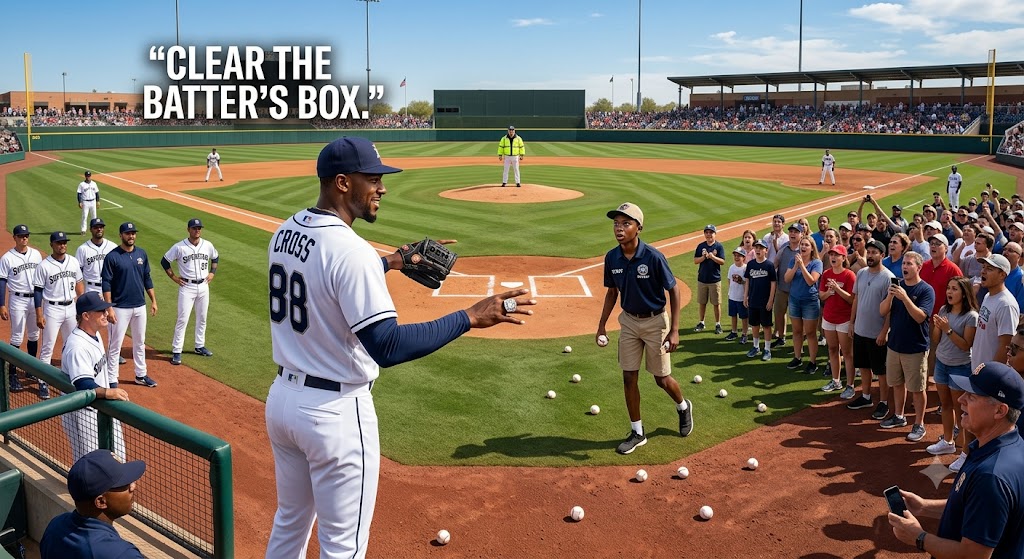
That arm couldn’t reach second base.
Miss, and you leave this field forever.
Sports shows replayed them.
Commentators laughed at Damian.
Some called him arrogant.
Others argued the whole thing was harmless entertainment.
Damian’s teammates teased him constantly.
One taped a paper sign above his locker:
DO NOT BET JEWELRY AGAINST TEENAGERS
Damian tore it down.
Someone replaced it the next day.
What bothered him most was not the jokes.
It was what Malachi said in the parking lot.
I wanted you to stop laughing.
Damian knew exactly what that felt like.
He had been sixteen once.
Poor.
Skinny.
Playing on a rural high-school field with a dirt warning track and two broken dugout benches.
Leonard Price had been the scout who noticed him.
Damian remembered the first conversation.
“You play summer ball?”
“No.”
“Travel?”
“No.”
“Showcases?”
“My family can’t do that.”
Leonard had nodded.
Then come back the following week anyway.
And the week after.
Damian had forgotten how important that was.
Success had turned his own past into a story he told during interviews.
He talked about being overlooked as though overcoming it made him special.
Then, years later, he looked at another kid wearing a field-crew shirt and made the exact same assumption people once made about him.
That realization embarrassed him more than losing the ring.
Three weeks after the fan day, Damian went to Malachi’s public-school field.
No media announcement.
No foundation banner.
Just Damian.
Leonard.
Rochelle.
Coach Hernandez.
And Malachi.
Malachi was taking ground balls.
When he saw Damian, he stopped.
“You brought the ring?”
Damian laughed.
“No.”
“Good.”
“I’m never taking it off near you again.”
Malachi smiled.
Damian leaned against the fence.
“I came to apologize.”
“You already did.”
“Not really.”
He looked toward Rochelle.
“She made me say words in a parking lot while I was afraid of her.”
Rochelle shouted from the bleachers.
“Smart man.”
Damian smiled.
Then he looked at Malachi.