“I made you prove you belonged on a field you were already working on.”
Malachi said nothing.
“I did it because I assumed your shirt told me who you were.”
“Ball crew.”
“Yes.”
Damian nodded.
“And because people were watching.”
Malachi looked at him.
“That part matters?”
“A lot.”
“Why?”
“Because attention makes stupid people louder.”
Malachi laughed.
Damian continued.
“I was showing off.”
“I figured.”
“I thought you would miss.”
“I figured that too.”
“I also forgot something.”
“What?”
Damian pointed toward Leonard.
“He scouted me when nobody knew who I was.”
Malachi looked surprised.
Leonard said, “Unfortunately, yes.”
Damian ignored him.
“I didn’t have showcase money either.”
“You?”
“Not then.”
“No travel team?”
“Couldn’t afford it.”
Malachi stared.
“Then why’d you act like that?”
Damian nodded slowly.
“That is an excellent question.”
He did not try to defend himself.
“I think I got too used to being the guy everyone watches instead of remembering the kid nobody watched.”
Malachi looked down at his glove.
Damian continued.
“So I’m sorry.”
“Not because you lost.”
“Because I laughed before I knew.”
Malachi nodded.
“Okay.”
That was it.
No dramatic hug.
No instant friendship.
But it was honest.
Before Damian left, he asked for one throw.
Malachi narrowed his eyes.
“From where?”
“Shortstop.”
“To first.”
“That’s boring.”
“Exactly.”
Coach Hernandez rolled Malachi a ground ball.
Malachi fielded it cleanly.
Set his feet.
Threw chest-high to first.
Damian nodded.
“Good.”
Malachi grinned.
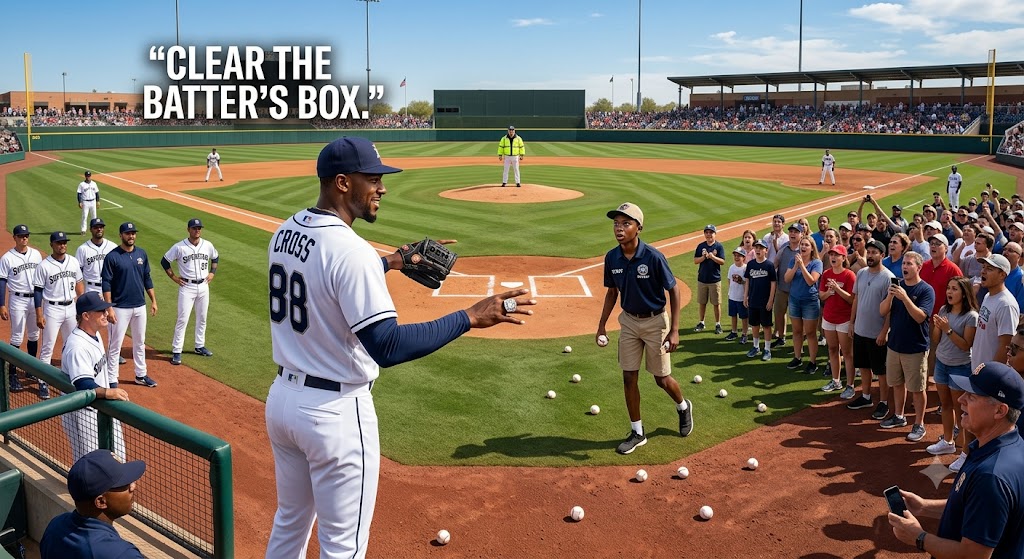
“Didn’t have to clear the batter’s box.”
“Please stop saying that.”
Over the next year, Malachi developed.
Not like a movie.
Progress was uneven.
He made his high-school team.
Then went through a three-week stretch where he could not hit an outside breaking ball.
Pitchers discovered it.
He struck out.
A lot.
His arm kept him on the field, but his bat nearly moved him to the bench.
Leonard watched one game where Malachi struck out three times.
Afterward, Malachi expected a lecture.
Leonard said:
“Good.”
Malachi stared.
“I went zero for four.”
“You needed it.”
“That doesn’t make sense.”
“You’ve had too many people telling you about one throw.”
Leonard pointed toward the field.
“This game does not care about your viral clip.”
Malachi sat beside him.
“I hate sliders.”
“Then learn them.”
“What if I can’t?”
“Then pitchers will throw you sliders until you are seventy.”
Malachi laughed.
He worked.
Coach Hernandez shortened his stride.
A hitting instructor taught him to recognize spin earlier.
Rochelle refused to let baseball interfere with school.
When Malachi’s algebra grade dropped, she took away extra batting-cage sessions.
Leonard did not interfere.
Damian thought she was terrifying.
Malachi thought so too.
By junior year, Malachi had become one of the better defensive shortstops in his region.
Not because of the freak throw.
Because his feet improved.
His decisions improved.
He stopped trying to make impossible throws when a simple one worked.
That lesson took longer than anyone expected.
Talent loved showing itself off.
Baseball often punished that.
During one important regional game, Malachi fielded a slow roller behind second base.
The old version of him would have planted and fired across his body.
The crowd expected it.
Instead, he realized the runner would beat the throw.
So he held the ball.
Another runner tried to advance to third.
Malachi turned and threw there.
Out.
Inning over.
Leonard sat in the stands.
That play impressed him more than the ring throw.
Afterward, Malachi asked:
“You saw that?”
“Yes.”
“I didn’t throw to first.”
“I noticed.”
“You proud?”
“No.”
Malachi rolled his eyes.
Leonard smiled.
“Very.”
By then, college coaches knew Malachi’s name.
Some had first discovered him through the viral video.
Others saw him later.
Leonard made sure the story did not become a promise.
No one could guarantee professional baseball.
Arms got hurt.
Bodies changed.
Hitters stalled.
Life happened.
What Malachi had earned was not destiny.
He had earned attention.
A fair look.
That distinction mattered.
The championship ring remained with Damian Cross.
He wore it less often afterward.
Not because the memory embarrassed him.
Because its meaning had changed.
Before the fan day, the ring represented a championship.
Afterward, it also represented the moment a fifteen-year-old reminded him how dangerous certainty could become.
Years later, Damian spoke at a youth baseball clinic.
A child asked him the question everyone eventually asked.
“Did Malachi really hit your ring from center field?”
Damian laughed.
“Yes.”
“With one throw?”
“Yes.”
“Were you mad?”
“For about six seconds.”
“What happened to the ring?”
Damian held up his hand.
“Still here.”
The child looked confused.
“But he won it.”
“He gave it back.”
“Why?”
Damian thought about the parking lot.
“I think because he wanted something else more.”
“What?”
Damian looked toward the field, where dozens of children were playing catch.
“To be taken seriously.”
By then, Malachi was eighteen.
His high-school career was ending.
He had scholarship offers.
No giant mansion.
No guaranteed professional contract.
No magical future written because of one throw.
Just options.
Real options.
Rochelle kept every recruiting letter in a plastic folder beside the refrigerator.
Malachi pretended that embarrassed him.
It did not.
One evening, Leonard visited their apartment.
Rochelle made chicken.
Malachi complained Leonard was always early.
Leonard said being on time was late.
After dinner, Rochelle brought out a box.
Inside was Malachi’s old field-crew shirt.
The faded one.
FIELD CREW
Leonard smiled.
“You kept it?”
Rochelle said, “Of course.”
Malachi groaned.
“Please don’t frame it.”
“I’m framing it.”
“Mom.”
“Next to the scholarship letter.”
“Mom.”
Leonard laughed.
Then Rochelle handed the shirt to her son.
Malachi ran his thumb across the letters.
He had almost forgotten how small the shirt felt now.
“You know what’s weird?” he said.
Leonard looked at him.
“I thought that ring throw changed everything.”
“It changed some things.”
“Not the biggest thing.”
“What did?”
Malachi looked at the old shirt.
“You coming back the next day.”
Leonard became quiet.
“Anybody could watch one throw.”
Malachi continued.
“You came back when there weren’t cameras.”