Mi madre rechazó todas las ofertas hasta que un abogado independiente las revisó.
Arthur aceptó.
“La gente que te ignoró ayer te atacará hoy”, me dijo.
“La atención no es respeto.”
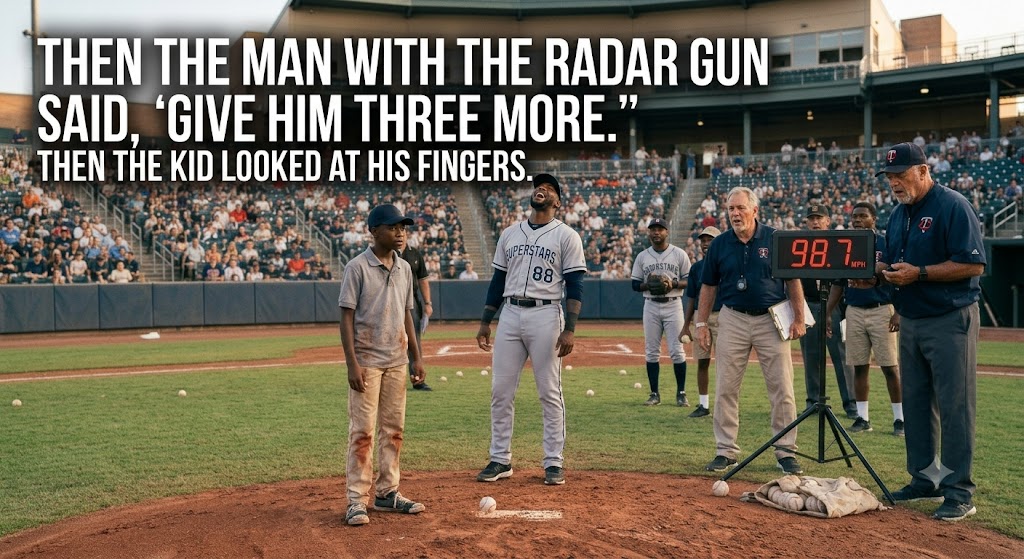
Mi presentación a noventa y ocho millas por hora se hizo famosa en internet.
Los clips en cámara lenta recibieron millones de visualizaciones.
Los niños intentaron copiar la Benton Fall.
Los programas deportivos me llamaban una futura superestrella.
Arthur vio una entrevista y apagó la televisión.
“Has lanzado cuatro lanzamientos.”
“Tres de verdad.”
“Exacto.”
“¿No crees que soy bueno?”
“Creo que tu brazo tiene quince.”
Esa respuesta me decepcionó.
Entonces entendí que protegía algo que Ryan nunca había protegido.
Mi futuro.
Arthur elaboró un plan de entrenamiento centrado en el control, la fuerza, el descanso y la escuela.
Limitó mis lanzamientos.
Se negó a permitir que los scouts asistieran a sesiones privadas.
Cuando un equipo me ofreció ponerme en una exhibición inmediatamente, Arthur dijo que no.
El ejecutivo le recordó que yo había tirado noventa y ocho.
Arthur respondió: “Un número de radar no es permiso para usar a un niño.”
Volví al béisbol escolar.
Por primera vez, me permitieron lanzar en un partido oficial.
Mi primera salida fue terrible.
Di tres bases por bolas.
Golpea otro.
Lanzó dos lanzamientos descontrolados.
La multitud había venido esperando la caída Benton.
Apenas encontré la zona de strike.
Después de la tercera entrada, me senté en el banquillo con una toalla sobre la cabeza.
Mi padre estaba sentado en las gradas.
Arthur estaba detrás de la valla.
Ninguno se acercó a mí.
El entrenador Ellis se agachó junto al banquillo.
“¿Has terminado?”
Le miré.
“¿Por hoy?”
“Por ti.”
Quité la toalla.
“No.”
“Bien.”
Volví para la cuarta entrada.
Dejé de intentar lanzar noventa y ocho.
Lancé ochenta y siete.
Luego ochenta y cinco.
He encontrado la placa.
La caída de Benton llegó en la sexta entrada con dos strikes.
El bateador se balanceó sobre ella.
El receptor mantuvo la bola un segundo.
Luego lo devolví.
No hay pantalla en el estadio.
No hay cámaras nacionales.
Nada de risas de superestrella.
Solo un lanzamiento limpio en un partido de instituto.
Se sentía mejor que con noventa y ocho.
Perdimos 5–3.
Mi madre nos llevó a comer hamburguesas después.
Lionel se sentó frente a mí.
“Te quedaste dentro de ti mismo.”
“¿Antes decías eso?”
“No.”
“Arthur sí.”
Mi padre sonrió.
“Me lo robó.”
Arthur, sentado al final de la mesa, levantó un dedo.
“A diferencia de ciertas personas, yo doy crédito.”
Nos reímos.
It was the first baseball joke that did not feel haunted.
Three years later, I stood on the mound at Keystone Field again.
The stadium had changed.
The underground laboratory was sealed and converted into an evidence archive before being permanently closed.
The Calloway name had been removed from the youth academy.
A new sign stood above the entrance.
THE BENTON-WYNN CENTER FOR FAIR PLAYER DEVELOPMENT
My father objected to his name being first.
Arthur objected to his name appearing at all.
The victims voted.
Both men lost.
The center offered free evaluations, independent medical records, legal support, and travel scholarships.
No player’s insurance information could be shared with a team or sponsor.
Every scouting score remained visible to the player and family.
Alterations created permanent alerts.
A wall inside listed the fifty-eight athletes whose identities were used.
Not as failed prospects.
As people the system failed.
I had accepted a college scholarship instead of entering professional baseball immediately.
Some commentators called that a mistake.
They said a pitcher throwing near one hundred miles per hour should capitalize while healthy.
My mother used a different word.
“Education.”
My father used another.
“Choice.”
Arthur simply asked whether I had completed my history assignment.
At eighteen, I returned to Keystone for the center’s opening ceremony.
Children filled the same lower seats where Ryan once laughed at me.
Several wore secondhand gloves.
Some arrived in borrowed uniforms.
No one announced which families needed financial help.
Arthur stood behind the backstop with the same black radar gun.
My mother sat in the first row.
Lionel stood beside her.
They were not remarried.
They were not pretending the lost years had disappeared.
But they had learned how to sit beside each other without silence becoming a weapon.
The ceremony organizers asked me to throw the first pitch.
I stepped onto the mound.
A twelve-year-old catcher crouched behind home plate.
He wore a chest protector held together near one strap with black tape.
Before I began, a man near the dugout called out.
“Show us a hundred!”
A few people laughed.
Arthur lifted the radar gun.
Then lowered it.
“Throw the pitch you need,” he said.
I placed two fingers close together.
My thumb rested beneath the smooth leather.
My father watched.
I lifted my knee.
The ball left my hand at eighty-nine miles per hour.
It traveled toward the center of the plate.
Then dropped.
The catcher closed his glove around it.
The crowd applauded.
Arthur checked the reading.
He did not announce it.
The number was not the story anymore.
Afterward, the young catcher approached me.
“How do I learn that pitch?”
“First, you learn to throw safely.”
“But when do I learn the fall?”
“When your arm is ready.”
“What if someone else learns it first?”
I looked toward the wall containing my father’s original notebook.
“A pitch doesn’t disappear because another person throws it.”
“What if they rename it?”
“Then you keep the records.”
He frowned.
“That’s not very baseball.”
“It is now.”
He nodded seriously.
Then ran back to his team.
My father joined me near the mound.
He carried the old dented metal box.
Inside were his notebooks, the first payment agreement, and the memory card that brought him back.
The box would be displayed in the center’s archive.
“You sure?” I asked.
“For years, I hid everything important.”
He placed the box in my hands.
“I’m trying something different.”
We walked toward the new exhibit together.