“And nobody uses my father’s name to sell tickets.”
Samuel spoke.
“I would like to honor Elijah.”
Danielle faced him.
“Honor is not a video before a game.”
“What would it be?”
“Telling the truth.”
Samuel waited.
Danielle continued.
“My father was not a secret legend waiting for somebody famous to discover him.”
“He was a working man who was denied chances.”
“He was underpaid.”
“He was released after playing better than men who stayed.”
“When teams finally offered him coaching work, they expected gratitude without apology.”
“If the Hawks want to honor him, put all of that on the plaque.”
Samuel’s eyes became wet.
“All of it,” he said.
Micah entered the fall program.
The first weeks humbled him.
His grandfather had taught him fundamentals, but formal competition exposed weaknesses backyard training could hide.
Micah struggled against breaking balls.
He took poor routes on high fly balls.
He threw accurately but sometimes too carefully.
Other players were stronger.
Several had private coaches.
Some had played travel baseball since they were eight.
Micah arrived wearing old cleats and carrying Elijah’s glove.
He was not immediately the best player.
That mattered.
Talent stories often skipped the work between discovery and achievement.
Micah could not.
He woke at five thirty.
Caught a bus to school.
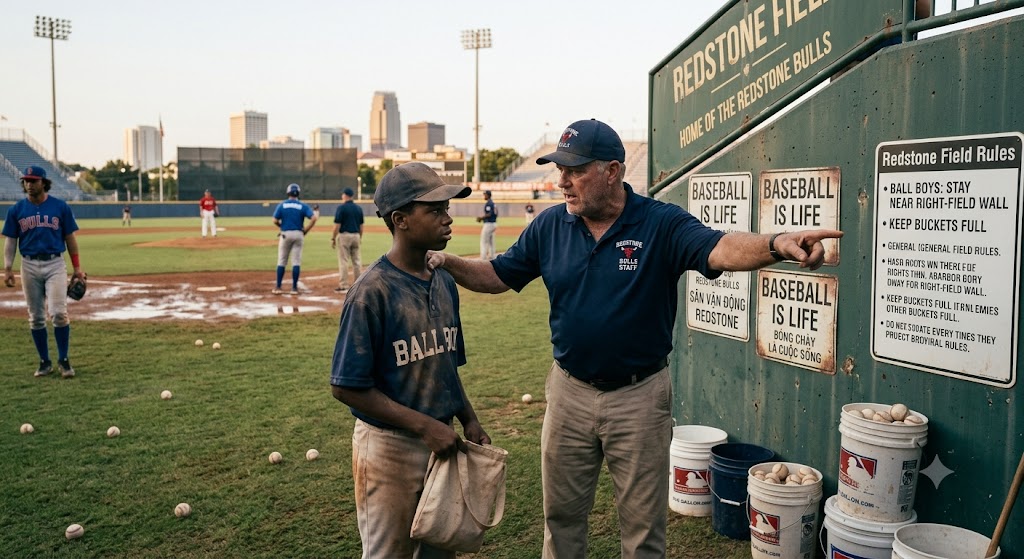
Worked two afternoons a week at Redstone Field.
Trained three evenings.
Completed homework after ten.
Danielle refused to let baseball excuse poor grades.
“If your legs are too tired to finish algebra,” she said, “they are too tired to chase baseball.”
Samuel attended practice every Thursday.
He taught Micah the details Elijah had once taught him.
How to position his feet before a throw.
How to watch a runner without staring.
How to make the same arm action produce different hops.
But Samuel did not replace Elijah.
He never tried.
When Micah asked what his grandfather had been like as a young player, Samuel told the flattering stories and the difficult ones.
Elijah hated bunting.
He argued with umpires.
He once missed a team bus because he stayed behind to help a stadium worker repair a broken gate.
He sent half his winter-league salary home to his younger sisters.
He also stopped speaking to Samuel after Samuel failed to defend him during a confrontation with a coach.
That was the real reason Elijah ignored the later calls.
Samuel had remained silent when speaking might have cost him a promotion.
“I told myself I was young,” Samuel said.
“I told myself I had no power.”
“Both were true.”
“Neither made the silence harmless.”
Micah listened carefully.
“Did Grandpa forgive you?”
“I don’t know.”
“That means no.”
“Maybe.”
“Did you forgive yourself?”
Samuel looked across the field.
“That is not the question that matters.”
“What is?”
“Whether I became someone who would speak the next time.”
Bryce began visiting the fall program too.
At first, the young players gathered around him.
They wanted photographs and batting tips.
Bryce gave both.
Then he asked Mendoza to let him work with the outfielders.
His relationship with Micah remained awkward.
An apology had not erased the humiliation.
Bryce understood that.
He did not force friendship.
He threw batting practice.
Corrected Micah’s shoulder movement.
Showed him how professional hitters studied pitchers between at-bats.
When Micah disagreed, Bryce listened before answering.
One afternoon, Bryce hit ground balls to the outfielders.
Micah charged one too quickly and allowed it to pass beneath his glove.
Bryce called him in.
“What happened?”
“I came up early.”
“Why?”
“I wanted to throw before I caught it.”
Bryce nodded.
“Pride tried to finish the play before your hands did.”
Micah looked at him.
“That sounds like something Samuel says.”
“It is something I did for ten years.”
“You still do it.”
Bryce laughed.
“Yes.”
“I still do it.”
By October, Micah had added strength.
His throws traveled farther without losing accuracy.
His swing became shorter.
He learned to recognize spin.
At the final fall scrimmage, East Ridge High’s head coach, Warren Pike, stood behind the backstop.
He had been invited by Mendoza.
Micah saw him before the game.
The same coach had cut him in March.
Coach Pike approached.
“You have improved.”
Micah said nothing.
“I may have evaluated you too quickly.”
“You said I was too small.”
“I was filling specific roster needs.”
“You kept two outfielders who were smaller.”
Pike looked uncomfortable.
“That decision involved several factors.”
“What factors?”
Samuel stood nearby but did not interfere.
This was Micah’s conversation.
Pike glanced toward him.
“Experience.”
“They had travel-team recommendations.”
“They also came from strong programs.”
“My grandfather trained me.”
“That was not documented competition.”
Micah nodded.
“So you trusted the people who recommended them.”
“Yes.”
“But you did not ask who trained me.”
Coach Pike lowered his voice.
“I am asking now.”
Micah looked toward Samuel.
Then at Bryce near the batting cage.
Finally, he looked at Elijah’s glove.
“My grandfather was Elijah Boone.”
“I know that now.”
“You didn’t need to know his name.”
Pike frowned.
“What do you mean?”
“You could have watched me throw.”
The coach had no answer.
Micah continued.
“I will try out again.”
“I hope you do.”
“But I do not want a place because Samuel spoke to you.”
“You will receive the same evaluation as everyone else.”
Micah held his gaze.
“No.”
“I want a better evaluation than everyone received last year.”
Pike stared at him.
Then he nodded.
“That is fair.”
During the winter, the Hawks announced that Elijah Boone would be inducted into the Redstone Baseball Heritage Hall.
Danielle approved the wording only after reviewing it four times.
The announcement did not call Elijah an overlooked hero.
It stated that he had been denied advancement despite documented performance.
It listed his statistics from independent leagues.
It described unequal pay, unstable contracts, and the organizational decisions that kept him from the highest level.
It also included the names of other players whose careers followed similar paths.