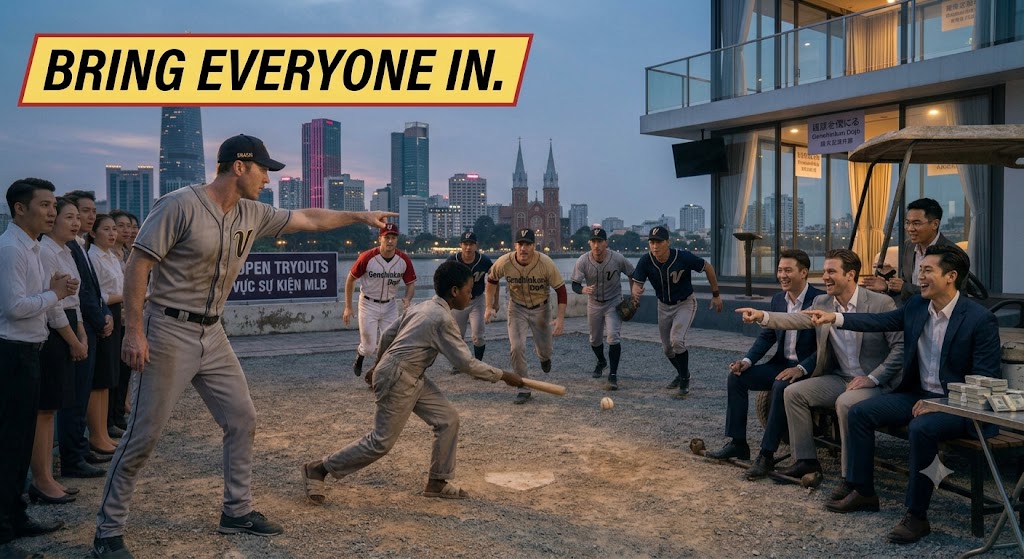
Brent celebrated as if he had won a postseason game.
“There.”
Cameron walked back.
Owen asked:
“What happened?”
“Bad angle.”
“Whose?”
“Mine.”
Brent said:
“Or maybe reality.”
Cameron ignored him.
Owen asked:
“Why bad?”
Cameron pointed toward Brent.
“I thought he’d keep his glove hand lower.”
Brent looked surprised.
Owen asked:
“You were watching his glove?”
“Yes.”
“Why?”
“Because if he charges with the glove already low, he can field through the ball.”
“And if it’s high?”
“He has to drop.”
Owen nodded.
“How much time?”
Cameron shrugged.
“Not much.”
“Enough?”
“Sometimes.”
Owen smiled.
That answer was the reason he kept testing.
Cameron did not claim magic.
He understood margins.
Owen arranged five more bunts.
No money involved now.
No spectacle.
Testing.
Cameron beat one.
Lost four.
On one, he was out badly.
On another, the bunt went foul.
Brent started laughing again.
Owen did not.
He wrote something on a card.
Then asked Cameron to run from home to first without swinging.
Cameron did.
Again.
Then again.
A strength coach timed him.
The numbers were good.
Very good for fourteen.
But not unbelievable.
Brent looked confused.
“I thought he’d be faster.”
Owen said:
“He isn’t winning because of top speed.”
Then he marked the first ten feet.
“Time that.”
Cameron ran.
The strength coach looked at the stopwatch.
Then again.
Another time.
Owen nodded.
“There.”
“What?”
“Acceleration.”
Cameron reached near-max running form unusually early.
But even that was only part of it.
Owen returned him to the batter’s box.
“Normal swing stance.”
Cameron set up.
“Run.”
He did.
Then:
“Bunt stance.”
Run.
The difference was obvious.
From bunt position, Cameron effectively removed part of the transition most batters needed after contact.
Owen said:
“That’s the stolen distance.”
Brent folded his arms.
“So he’s gaming the box.”
Owen turned.
“You mean using it?”
Brent said nothing.
Owen continued:
“The batter’s box has legal boundaries.”
“He knows them.”
“The defense has responsibilities.”
“He knows those too.”
“The pitcher has momentum.”
“He watches it.”
“The corner men have preferred glove paths.”
“He watches those.”
Owen looked toward Cameron.
“How long have you been doing this?”
Cameron answered:
“A few years.”
“Who taught you?”
“Coach Neal started it.”
“Where?”
“Jefferson Community Field.”
Owen recognized the name.
“Reggie Neal?”
Cameron nodded.
Owen laughed.
“Of course.”
Brent frowned.
“You know him?”
“Everybody who coached youth baseball in this city knows Reggie.”
“What is he, some old pro?”
“No.”
Owen smiled.
“High-school geometry teacher.”
That got a laugh.
Then Owen added:
“And one of the smartest baserunning coaches I’ve ever met.”
Reggie Neal arrived at the stadium forty minutes later.
Owen called him.
He was sixty-seven, retired, wearing khaki pants and a polo shirt with a faded school logo.
When he saw Cameron, he pointed.
“You in trouble?”
Cameron smiled.
“Maybe.”
Reggie looked at the cameras.
Then the players.
Then Brent.
“What did you do?”
Brent answered:
“He took twenty thousand dollars from me.”
Cameron said:
“I haven’t taken anything.”
“Technicality.”
Reggie looked at Owen.
“What happened?”
Owen showed him the video.
First bunt.
Then the full-infield attempt.
Reggie watched without speaking.
At the safe frame, he smiled.
“Movement space.”
Cameron nodded.
Owen heard it.
“What does that mean?”
Reggie explained.
“When kids learn bunting, everyone tells them to put the ball where nobody is.”
“That works until defenses move in.”
“So I taught them another question.”
“Where is somebody leaving?”
Owen looked toward the field.
Reggie pointed to the video.
“First baseman attacks.”
“Second baseman moves to cover.”
“Pitcher finishes to one side.”
“Catcher clears the plate.”
“Everybody has a route.”
“Make the ball arrive where routes become decisions.”
Brent stared at the screen again.
“You’re saying he planned three guys converging?”
“No.”
Reggie shook his head.
“He planned to give three guys a reason to think the ball was theirs.”
Different.
That line stayed with Owen.
Marissa finally reached Cameron.
She grabbed his arm.
“Are you hurt?”
“No.”
“You dove headfirst.”
“I know.”
“Do not ‘I know’ me.”
“Sorry.”
Then she looked at Brent.
He raised both hands.
“I accept responsibility for whatever comes next.”
Marissa pointed at the envelope.
“What exactly is that?”
Brent looked toward the team’s community director.
The expression on her face made it clear the legal department had already developed a headache.
“Money.”
“I can see that.”
Brent explained the bet.
Marissa stared at him.
“You bet twenty thousand dollars against a fourteen-year-old?”
“When you say it that way—”
“How else is there to say it?”
Nobody helped him.
Cameron whispered:
“Mom.”
She looked at him.
“You.”
He stopped.
Then Brent said:
“He won.”
Marissa looked back.
“So?”
“So I pay.”
She folded her arms.
“My son is not taking twenty thousand dollars in cash from a grown man on a baseball field.”
Cameron’s shoulders dropped.
Brent seemed almost relieved someone else understood there were practical problems.
Then Owen said:
“Put it somewhere useful.”
Marissa looked at him.
He explained.
Education.
Baseball expenses.
Household support through a properly structured charity grant if allowed.
No envelope of money handed to a minor.
No stunt.
The community director finally breathed again.
Marissa said:
“I don’t want this turned into a pity story.”
Cameron looked down.
She continued:
“My son works because our family works.”
“He is not a mascot for poverty.”
“He did something well.”
“If the team wants to recognize that, fine.”
“But don’t put sad music behind him and show his shoes.”
Brent looked at Cameron’s taped shoes.
Then quickly looked away.
Owen smiled.
“Yes, ma’am.”
The $20,000 eventually became two things.
Part went into an education fund for Cameron.
Part went to a youth baseball transportation program in the neighborhood where he had learned to bunt.
Brent insisted.
Cameron asked why.
Brent said:
“Because if I only help you, I turn the whole thing into me discovering one special kid.”
“You didn’t discover me.”
“I’m learning that.”
That was the beginning of Brent changing.
Not instantly.
Not dramatically.
He was still Brent Maddox.
Still competitive.
Still liked attention.