Alicia Warren offered to change it.
Isaiah thought for a moment.
“Keep it until another ball boy gets a real tryout.”
The following spring, Dawson Field hosted its first showcase under the new system.
Isaiah returned wearing jersey number twenty-two.
Not an oversized uniform.
Not a worker’s shirt.
His name appeared in the official program.
ISAIAH REEDRHPAGE 16
Rochelle sat behind home plate with Naomi.
Earl occupied the seat beside them, though he complained that spectators left sunflower-seed shells everywhere.
Daniel Mercer stood near the scouts.
Mason waited in the bullpen wearing the uniform of a different travel team.
His listed velocity was eighty-nine.
That number was accurate.
Before the session, Isaiah found a Black boy of about thirteen collecting baseballs near the first-base line.
The boy watched every pitcher.
Isaiah recognized the look.
“What’s your name?” he asked.
“Terrence.”
“You pitch?”
The boy shrugged.
“Sometimes.”
“That means yes.”
“My coach says I’m too short.”
“How tall is the strike zone?”
Terrence smiled.
Isaiah handed him a clean baseball.
“Grip it.”
Terrence placed his fingers across the wide seam.
Isaiah adjusted them slightly.
“Pressure here.”
A staff member called Isaiah toward the bullpen.
He started to leave.
Then he turned back.
“There’s an open evaluation after lunch.”
“I’m working.”
“So was I.”
Terrence looked toward the registration tent.
“I don’t have the fee.”
“It’s free for staff.”
“Since when?”
Isaiah smiled.
“Since somebody finally read the rules.”
During his official session, Isaiah warmed for twelve minutes.
The trainer checked his shoulder.
Earl counted pitches.
No one handed him a scuffed ball.
No one threatened his job.
He stepped onto the mound beneath a quiet crowd.
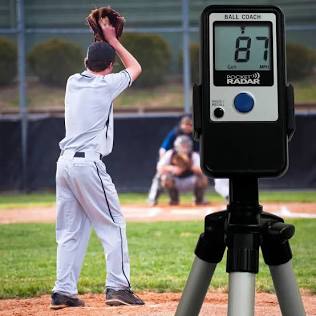
The radar gun stood on a fixed tripod behind home plate.
A second certified unit operated beside it.
Both connected to the public display.
Isaiah threw his first fastball.
95 MPH.
The next reached ninety-six.
Then ninety-seven.
The crowd applauded.
Isaiah stepped off the rubber after five pitches, exactly as his development plan required.
One scout asked for another.
Earl answered from the railing.
“He’s finished.”
The scout looked annoyed.
Isaiah smiled.
For once, someone was protecting his future instead of selling it.
Mason pitched later.
His first throw reached eighty-eight.
The second reached eighty-nine.
His fifth touched ninety.
He looked toward the display.
Then toward Isaiah.
Isaiah raised one fist.
Mason returned the gesture.
Ninety belonged to him.
After the showcase, Terrence completed the open evaluation.
He threw seventy-four miles per hour.
Not a miracle number.
Not enough to make scouts leave their seats.
But his curveball moved sharply, and he placed six consecutive pitches at the bottom of the strike zone.
A local coach invited him to a development clinic.
Terrence carried the invitation toward his mother as if it were a major-league contract.
Isaiah watched from the dugout.
Earl sat beside him.
“You did that,” the old man said.
“He threw the pitches.”
“You opened the gate.”
Isaiah looked toward the radar display.
“It was only seventy-four.”
Earl frowned.
“Have you learned nothing?”
Isaiah smiled.
“The number isn’t everything.”
“The number is information. People decide what it means.”
The sun lowered behind the left-field wall.
Families packed chairs and equipment into cars.
Staff members collected baseballs from the outfield.
Isaiah saw one lying near the mound.
He walked out and picked it up.
The ball was clean except for a small grass stain.
He rolled it between his fingers.
One year earlier, Coach Brent Harlan had placed a damaged ball in his hand and expected humiliation.
Brent believed the mound belonged to the players whose parents paid him.
He believed a ball boy could be invited upward only as a joke.
He believed the radar gun would confirm the difference between them.
Instead, the machine showed ninety-six.
Then ninety-eight.
But Isaiah eventually understood that those numbers were not the most important things hidden inside the device.
The stored history held months of choices.
Speeds raised for boys whose families could pay.
Speeds lowered for boys Brent wanted to control.
Isaiah’s pitches transferred to another name.
Talent turned into someone else’s marketing.
Doubt assigned to children who had done nothing wrong.
The radar gun had measured baseballs.
Brent had used it to measure worth.
That was his real crime.
A player throwing eighty-four was not less honest than one throwing ninety-four.
A boy who needed financial aid did not deserve a lower number.
A coach’s son did not need a lie to become valuable.
And a Black teenager carrying buckets did not become talented only when a screen finally displayed the proof.
Isaiah had possessed the arm before the crowd saw it.
He had practiced before dawn.
He had repaired his glove.
He had listened to Earl.
He had protected his mother from expenses she never asked him to carry.
The radar gun did not create any of that.
It only made denial harder.
Isaiah placed the baseball inside his bag.
As he left the field, he passed the equipment room where the old radar unit had once been stored.
The shelf was empty.
The council had placed the device in its training archive with a small card explaining the scandal.
Isaiah had been invited to write a sentence for the display.
He chose nine words.
A number should reveal effort, not hide someone’s choices.
Outside, Rochelle waited beside their old car.
The transmission still slipped on hills, though the regional program had offered to help repair it.
Rochelle insisted on paying part of the bill herself.
Naomi sat in the back seat wearing Isaiah’s cap.
Earl leaned against the passenger door.
“You ready?” Rochelle asked.
Isaiah looked back at the stadium.
Terrence was still near the gate, showing his clinic invitation to anyone who would look.
Mason carried his own equipment toward a team bus.
The showcase banner displayed no single player’s face.
Only an empty baseball field and four words:
EVERY PITCH COUNTS HONESTLY.
Isaiah climbed into the car.
“Ready.”
As they drove away, the field disappeared behind them.