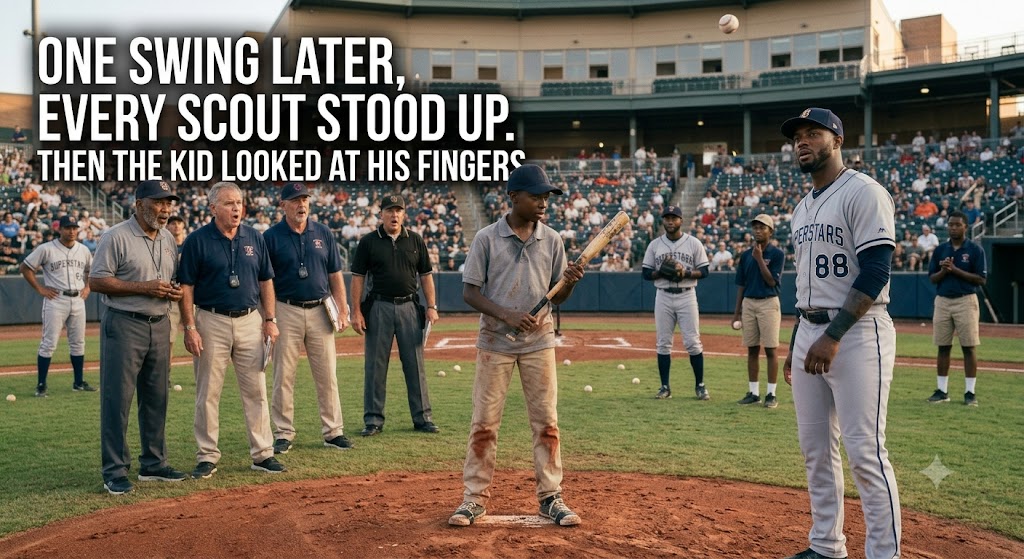
The boy stood too upright.
His front shoulder was slightly open.
His hands rested high near his right ear.
Nothing about the stance looked unusual.
Then Marcus tapped the plate twice.
Once near the outside corner.
Once near the inside corner.
Walt stopped writing.
He leaned forward.
Evan began his motion.
His front leg rose.
His shoulders turned.
The ball left his hand with a sharp hiss.
Marcus saw white for half a second.
Then the fastball struck the catcher’s mitt.
The sound echoed against the metal bleachers.
Marcus had not moved.
“Strike one!” Graves shouted.
A number appeared on the radar gun.
82 MPH
Several older players smirked.
Graves folded his arms.
“Too fast for you.”
Marcus stepped out of the box.
His heart pounded so hard he could feel it in his throat.
The pitch had been faster than anything he had faced.
At Roosevelt Middle School, the best pitcher threw in the low sixties.
Marcus had practiced against a pitching machine at the public batting cage, but the machine shook so badly that its speed rarely passed seventy.
Eighty-two felt different.
The ball did not travel toward him.
It appeared.
Lena moved toward the gate.
“That’s enough.”
Marcus held up one hand.
He closed his eyes.
He heard his grandfather’s voice.
Not from the field.
From their backyard three summers earlier.
Speed steals time, little man.
Marcus had been nine.
His grandfather, Elijah Reed, had stood behind him with both hands resting on Marcus’s shoulders.
So stop giving the pitcher time to steal.
Marcus opened his eyes.
He moved his back foot two inches closer to the plate.
He lowered his hands.
He turned his front knee inward.
Then he rested most of his weight on the inside edge of his back foot.
The change was small.
Most parents did not notice it.
Graves did not notice it.
Walt Harlan did.
He rose halfway from his chair.
Forty-seven years disappeared from his face.
He was no longer sitting at a youth showcase in Ohio.
He was standing beside a minor-league field in Tennessee in the summer of 1979.
A nineteen-year-old hitter had just made the same adjustment against a pitcher who threw harder than anyone in the league.
Back foot closer.
Hands down.
Knee turned inward.
Weight balanced on the inside edge.
Walt had seen hundreds of players imitate famous swings.
But no one had ever taught that movement publicly.
It belonged to one man.
Elijah Reed.
Walt stared at Marcus’s bat.
Black tape covered most of the handle.
Above it, two faded initials caught the sunlight.
E.R.
Walt stood completely.
The scout beside him glanced up.
“What is it?”
Walt did not answer.
Evan received the ball from the catcher.
“Again?” he asked.
Graves pointed at Marcus.
“Make him swing.”
Evan set his feet.
This time, he threw harder.
His body snapped forward.
The radar operator watched the numbers climb.
Marcus did not watch Evan’s face.
He watched the pitcher’s front shoulder.
Grandpa Elijah had taught him that too.
The hand can lie. The shoulder tells the truth.
Evan’s shoulder opened.
Marcus’s front heel touched the dirt.
His hips turned before his hands moved.
The bat came through the strike zone in one short, level line.
The crack was unlike any sound heard that morning.
It was not the hollow pop of a composite barrel.
It was the deep, clean explosion of old wood meeting the center of a baseball.
Every head turned.
The ball rose over the pitcher.
It climbed above center field.
The center fielder took three steps backward, then stopped.
The ball passed over the three-hundred-foot sign.
It cleared the outfield fence.
It cleared the walking path behind the fence.
It struck the metal roof of a maintenance shed and bounced into the parking lot.
For one second, no one moved.
Then every scout stood up.
Not some of them.
Every one.
Clipboards fell against knees.
Chairs scraped against concrete.
The radar operator looked from his screen to Marcus.
The number still showed Evan’s pitch.
84 MPH
Marcus remained in the batter’s box.
The bat rested over his left shoulder.
A thin new crack had appeared in the tape.
Evan turned toward the outfield.
His mouth hung open.
The catcher removed his mask.
Parents lowered their phones just enough to stare over them.
One of the older boys whispered, “No way.”
Graves said nothing.
His face had lost its color.
Walt Harlan moved before the ball stopped bouncing.
He pushed past the other scouts.
He descended the bleachers one step at a time, gripping the rail because his right knee no longer bent easily.
He did not look toward the outfield.
He did not look at the radar gun.
He looked at Marcus’s hands.
The boy’s right thumb rested across the handle.
His left index finger curved slightly away from the others.
The grip was unusual.
Elijah Reed had used it because of a childhood injury that left one knuckle stiff.
He had taught the grip to only one person Walt knew about.
His daughter.
Walt reached the gate.
“Boy,” he called.
Marcus turned.
Walt entered the field without asking Graves for permission.
The crowd separated for him.
He stopped three feet from Marcus and pointed toward the taped bat.
“Let me see the handle.”
Marcus held it tighter.
“It belonged to my grandpa.”
Walt’s breathing changed.
Behind the fence, Lena pressed one hand to her mouth.
Walt looked past Marcus and saw her.
For several seconds, he seemed unable to speak.
Then he asked the question that made the grocery envelope fall from Lena’s hand.
“Are you Elijah Reed’s daughter?”
The envelope struck the concrete.
The seventeen dollars slid across the ground.
Lena did not bend to pick them up.
She stared at Walt.
“How do you know my father?”
Walt removed his cap.
The scouts behind him exchanged confused looks.
Graves stepped forward.
“This is still my field.”
Walt did not turn.
“I asked you a question, ma’am.”