Lena opened the gate slowly.
“My name is Lena Reed.”
Walt closed his eyes.
When he opened them again, they were wet.
“I’ve been looking for your family for thirty-eight years.”
Elijah Reed had never spoken much about baseball.
Marcus knew his grandfather had played when he was young.
He knew there were old photographs in a shoebox beneath Lena’s bed.
In those pictures, Elijah stood in uniforms bearing names Marcus had never heard.
The Dayton Kings.
The Memphis Stars.
The Lake County Miners.
In one photograph, Elijah held the same wooden bat Marcus now carried.
He was twenty years old and smiling so widely that the expression looked almost unfamiliar.
The grandfather Marcus remembered had been quieter.
Elijah worked for the city transit department for thirty-two years.
He repaired buses in a concrete garage that smelled of oil and hot rubber.
He attended church on Sundays.
He kept peppermints in his shirt pocket.
He never missed one of Marcus’s school games.
When Marcus asked why he had stopped playing baseball, Elijah always gave the same answer.
“Life needed me somewhere else.”
Marcus had accepted that.
Children often accept the first answer adults give them, especially when the answer is spoken gently.
Lena knew more, but not everything.
She knew her father had once been offered a minor-league contract.
She knew the offer disappeared after a dispute with a manager.
She knew Elijah returned home with no money and refused to discuss what happened.
Years later, when Lena asked again, Elijah said only, “Some doors close because you aren’t good enough. Some close because somebody is afraid you are.”
Elijah died when Marcus was nine.
A heart attack took him while he was repairing a neighbor’s lawn mower.
Before the ambulance arrived, he asked Lena to bring him the old bat from the hall closet.
She placed it beside him.
He rested one hand on the taped handle and told Marcus, “Don’t let anybody make you ashamed of what you carry.”
Those were the last words Marcus heard him speak.
After the funeral, Marcus began using the bat.
Lena objected at first.
The wood was old.
The handle had already cracked.
It belonged on a wall, not at a practice field.
But Marcus refused every replacement.
When the crack widened, he wrapped it in black tape.
When the tape loosened, he added more.
The bat became heavier each year.
Marcus adjusted.
He learned to keep his hands inside the ball.
He learned to use his hips.
He learned to stop wasting movement.
Without realizing it, he rebuilt the swing Elijah had taught him.
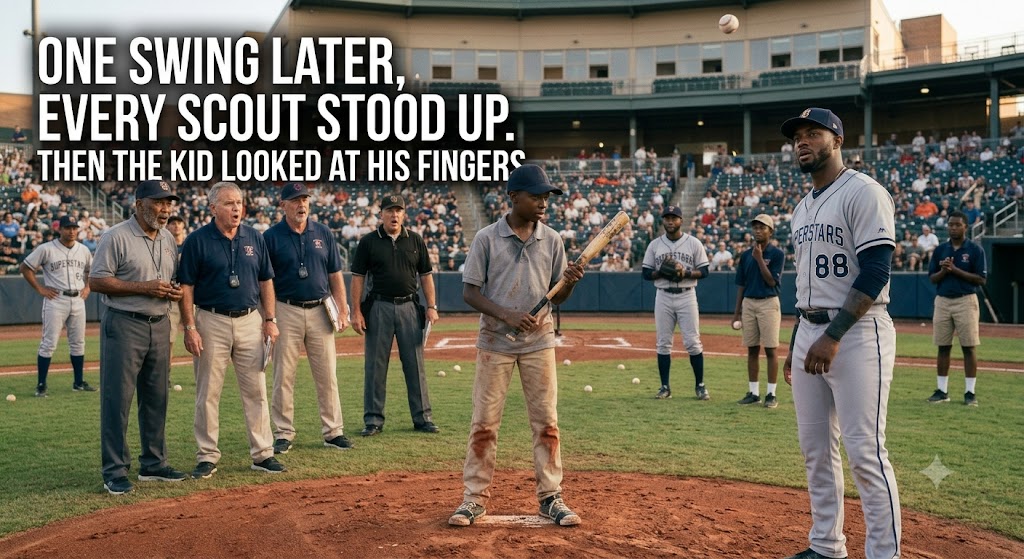
Now an elderly scout stood in front of him holding his cap against his chest.
Walt looked at the initials on the bat again.
“Elijah carved those before his first professional game,” he said.
Lena stepped closer.
“You knew him?”
“I signed him.”
The words caused another silence.
One of the scouts moved down from the bleachers.
Graves glanced toward the parents filming.
“This conversation needs to happen somewhere private.”
“No,” Lena said.
Her voice was tired, but steady.
“For years, everything about my father happened in private.”
Walt nodded.
“You’re right.”
He turned toward the bleachers.
“My name is Walter Harlan. In 1979, I was a twenty-nine-year-old area scout for the Milwaukee organization.”
Several parents recognized the name.
Whispers moved through the crowd.
Walt Harlan had signed three major-league All-Stars during his career.
His photograph hung in a regional scouting hall of fame.
He continued speaking.
“Elijah Reed was the best young hitter I had ever seen.”
Graves gave a short laugh.
It sounded forced.
“Better than a lot of people who actually reached the majors?”
Walt finally looked at him.
“Better than half the men I watched play there.”
No one laughed.
Walt faced Marcus again.
“Your grandfather could hit anything. Fastballs at his eyes. Breaking balls in the dirt. Inside pitches that should have broken his hands. He did not swing hard. He swung correctly.”
Marcus looked down at the old bat.
“What happened to him?”
Walt’s jaw tightened.
“I recommended that the organization move him from a temporary contract into the advanced minor-league system. The club agreed. He was supposed to receive a signing payment and report to our Florida affiliate.”
Lena folded her arms.
“He never went.”
“I know.”
“Why?”
“Because someone changed his evaluation.”
Walt spoke slowly now, as though every word carried weight he had been holding for decades.
“At the end of that summer, our regional director submitted a report claiming Elijah was difficult, undisciplined, and dishonest about his age. None of it was true.”
“Who wrote the report?” Lena asked.
“The director’s name was Calvin Graves.”
Every face turned toward Randall Graves.
His expression froze.
Walt pointed toward him.
“His grandfather.”
Randall recovered quickly.
“My grandfather has been dead for fifteen years. He can’t defend himself.”
“The report carried his signature.”
“That proves he wrote an evaluation. Scouts write negative evaluations every day.”
Walt nodded.
“They do. But Calvin also kept the signing payment.”
The crowd stirred.
Randall shook his head.
“This is ridiculous.”
“I discovered it six months later,” Walt said. “The club had issued Elijah a check for twenty-five thousand dollars. Calvin marked the payment as delivered.”
Lena’s lips parted.
In 1979, twenty-five thousand dollars could have changed Elijah’s life.
It could have moved his family out of the apartment where rain entered through the kitchen ceiling.
It could have paid for the surgery Elijah’s mother needed.
It could have given him time to play baseball instead of working two jobs.
“He never received it,” Lena said.
“No.”
“What happened to the money?”
“Calvin deposited it through a sporting-goods company he controlled.”
Randall stepped between Walt and the crowd.
“You have no evidence.”
Walt stared at him.
“I had evidence.”
“Had?”
“The club wanted the matter handled quietly. Calvin resigned. I was told Elijah would be contacted and paid.”
“But he wasn’t,” Lena said.
Walt lowered his eyes.
“No.”
“Why not?”
“The records disappeared.”