Then another.
Within two minutes, Lena held six business cards.
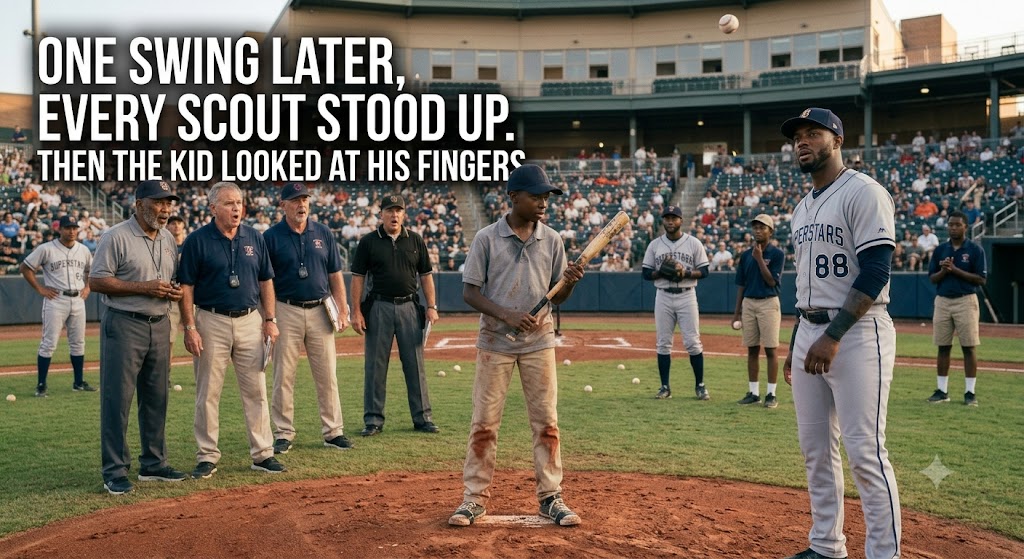
Randall Graves watched from across the field.
His phone call ended.
He walked toward them.
“Marcus remains registered under my showcase,” he said.
Renee turned.
“What does that mean?”
“It means any formal contact with the player goes through the event director.”
“He is twelve,” Lena said. “Contact goes through me.”
Randall ignored her.
“This field, the staff, and the exposure were provided by my organization. We are entitled to recognition for identifying the player.”
Marcus stared at him.
“You didn’t identify me.”
Randall’s face tightened.
“I put you at the plate.”
“You tried to embarrass me.”
“I tested you.”
“You laughed before I hit.”
Several parents nodded.
The videos had captured everything.
Randall looked toward Walt.
“You know how this business works. Players get emotional. Parents misunderstand coaching language.”
Walt stepped closer.
“I have heard cruel men call cruelty coaching for fifty years.”
“You’re destroying my reputation over one sentence.”
“No,” Lena said. “You built your reputation with that sentence. People just finally heard it.”
Randall turned toward her.
“You should be grateful your son was given an opportunity.”
Lena’s exhaustion seemed to disappear.
She stood straighter.
“My son was given nothing.”
“He was allowed to participate without paying.”
“His school coach earned that waiver by calling until someone listened.”
“My showcase put him in front of scouts.”
“My son put himself in front of scouts when he hit your fastest pitcher.”
Randall pointed toward the parking lot.
“I can have you removed.”
Renee Walker lifted her phone.
“Please try.”
Randall saw the live-stream indicator on her screen.
More than eight thousand people were already watching.
The number climbed each second.
The confrontation had spread beyond Field Three.
Parents had posted the original video.
The clip showed Randall looking at Lena’s grocery envelope before saying, “You want your mother to eat tonight? Then hit this.”
It showed the first pitch.
The insult.
Marcus changing his stance.
The home run.
The scouts standing.
People online were replaying the moment from different angles.
A local sports reporter had shared it.
Then a former major-league player shared it.
Then a national youth baseball account posted the clip with one sentence:
Talent should never have to survive humiliation to be seen.
Randall looked at the phones around him.
For the first time that morning, he understood that the audience no longer belonged to him.
The showcase ended early.
Three assistant coaches resigned before leaving the field.
The Falcons organization announced that Randall had been suspended pending review.
By evening, sponsors began removing their names from the program’s website.
The car dealer requested that its banner be taken down.
The sporting-goods company canceled a planned equipment donation.
Parents who had remained silent for years started telling their own stories.
One family said Randall had benched their son after they could not afford a team trip.
Another said he had demanded private training fees in exchange for playing time.
A former player described being called lazy while recovering from an undiagnosed heart condition.
A mother posted receipts showing she had paid thousands of dollars for a tournament her son was never allowed to enter.
The story became larger than one sentence.
The sentence had simply opened the door.
Lena did not watch the news that night.
She drove home with Marcus asleep in the passenger seat.
The old bat rested between them.
At a gas station twelve miles from home, she put ten dollars into the Buick.
Then she stood outside the convenience store holding the grocery envelope.
Seven dollars remained.
Through the window, she could see sandwiches beneath a heat lamp.
Marcus had not eaten since morning.
She purchased two.
When she returned to the car, Marcus was awake.
“You got two?” he asked.
“One for you.”
“What about the other?”
“For me.”
He watched until she took the first bite.
Only then did he unwrap his own.
They ate in the parked car beneath a flickering light.
No scouts.
No cameras.
No applause.
Just a mother and her son sharing dinner after a day neither of them yet understood.
“Was Grandpa famous?” Marcus asked.
“No.”
“But Mr. Harlan said—”
“Being talented and being famous aren’t the same.”
“Would he have made the majors?”
Lena looked through the windshield.
“I don’t know.”
“Do you think Coach Graves’s grandfather stopped him?”
“I think several people failed him.”
“Mr. Harlan too?”
“Yes.”
“But he’s helping now.”
“Yes.”
Marcus thought for a moment.
“Can somebody be good now if they were scared before?”
Lena folded her sandwich wrapper.
“They can do something good now. That doesn’t erase what they did before.”
Marcus looked down at the bat.
“Grandpa never said he was angry.”
“He was.”
“How do you know?”
“Because silence isn’t the same as peace.”
She touched the faded initials.
“Your grandfather carried what happened for the rest of his life. But he never gave it to you as hate.”
Marcus nodded slowly.
He understood only part of that sentence.
The rest would take years.
Walt visited Lena’s house the next afternoon.
He arrived wearing a navy blazer and carrying a metal document case.
Marcus opened the door.
“You found us.”
Walt smiled sadly.
“This time, yes.”
Lena invited him into the kitchen.
The house was small.
Elijah’s work jacket still hung beside the basement door.
A photograph of him holding Marcus as a baby stood on the refrigerator.
Walt stopped when he saw it.
“He got old,” he whispered.
Lena crossed her arms.
“That happens when thirty-eight years pass.”
“I deserved that.”
“Yes.”
They sat at the kitchen table.
Walt opened the metal case.
Inside were copies of scouting reports, letters, payroll records, photographs, and a yellowed contract.
Elijah’s name appeared across the top.
This time, the full name was correct.
Elijah Raymond Reed
The contract offered a minor-league position, a twenty-five-thousand-dollar signing payment, and additional money if he advanced beyond Class A.
Lena read every page.
Marcus stood behind her chair.