His uniform was still simple.
No private-club logo.
No expensive batting gloves.
But no one placed his name at the bottom of a list.
Every player received four timed sprints.
Every player fielded ten ground balls.
Every player took fifteen swings.
The coaches did not know which families paid and which received assistance.
Before batting practice, Marcus opened his equipment bag.
The old wooden bat rested inside.
The crack had spread almost completely through the handle.
Walt had warned him never to hit with it again.
One more swing could split it apart.
Renee approached.
“You bringing that to the plate?”
Marcus shook his head.
“Not anymore.”
He lifted a new wooden bat.
It had been made to the same measurements as Elijah’s.
Thirty-four inches was too long for most twelve-year-olds, so the company produced a lighter version while preserving the thin handle.
Above the knob, Marcus had carved two sets of initials.
E.R.
Beneath them:
M.R.
He carried the new bat toward the field.
The old one remained in the bag.
Not abandoned.
Protected.
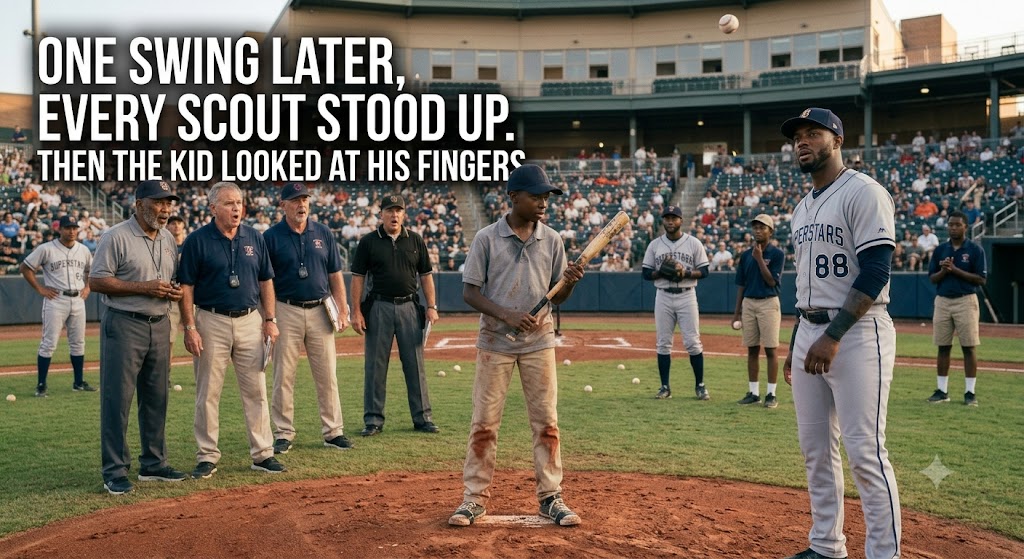
When Marcus stepped into the batter’s box, no one insulted him.
No one mentioned his mother.
No one ordered a pitcher to humiliate him.
A coach called out, “Take your time.”
Marcus tapped the outside corner.
Then the inside.
He lowered his hands.
Turned his knee.
Balanced his weight.
Walt stood behind the fence with Lena.
The pitcher delivered.
Marcus hit a line drive over the second baseman’s head.
His next swing sent the ball into the right-center gap.
On the third, he waited on a breaking ball and drove it down the left-field line.
The scouts wrote in their notebooks.
Not because of a viral video.
Not because of Elijah’s stolen history.
Because Marcus could play.
After the session, Renee posted the camp evaluations.
Marcus ranked first in contact rate, third in exit speed, and second in defensive range among players his age.
He did not receive a professional contract.
He was twelve.
He did not become an instant celebrity.
He returned home and finished his summer reading assignment.
He helped Lena carry groceries.
He struck out twice in his next middle-school game.
Talent did not remove failure.
Justice did not make life easy.
But from that day forward, Marcus failed and succeeded on the field for honest reasons.
That was all Elijah had ever wanted.
The following spring, the city dedicated Field Two at Roosevelt Park in Elijah Reed’s name.
The field had once been little more than uneven grass, rusty benches, and a backstop patched with wire.
The Opportunity Fund repaired it.
New dirt covered the infield.
The dugouts received roofs.
A small equipment shed held donated gloves, helmets, bats, and cleats that any child could borrow without explanation.
A plaque near home plate displayed Elijah’s photograph from 1979.
He stood holding the old bat, smiling toward a future that had been taken from him.
Beneath the photograph were the words:
ELIJAH REED FIELD
Talent exists everywhere. Opportunity does not.
More than three hundred people attended the dedication.
Walt stood near the back.
He had offered to remain out of the ceremony.
Lena asked him to come.
She had not forgiven every choice he made.
Forgiveness was not a door that opened in one movement.
But Walt had testified publicly.
He had surrendered his old records.
He had helped restore Elijah’s name.
He visited local programs and spoke to scouts about the cost of silence.
He did not present himself as a hero.
That made it easier for Lena to accept his presence.
Evan Cole attended too.
He and Marcus had become friends.
Evan’s father transferred him out of the Falcons and into a community-based program.
When reporters asked Evan about the famous pitch, he always gave the same answer.
“I threw one good fastball. Marcus did the hard part.”
Renee Walker spoke first.
Then the mayor.
Then Walt.
He stood at the microphone with the old wooden bat in his hands.
The tape had been removed carefully.
The crack remained visible.
So did Elijah’s initials.
“I spent my life searching for baseball talent,” Walt said. “But the most important player I ever signed disappeared because people with authority chose convenience over truth.”
He looked toward Lena.
“Some of us caused that harm directly. Others caused it by staying quiet.”
The crowd remained still.
“Elijah Reed deserved more than an apology made after his death. He deserved the career he earned. We cannot return it.”
Walt turned toward the children gathered along the first-base line.
“But we can stop demanding that the next child prove his worth while adults decide whether his family looks important enough.”
He placed the bat inside a glass display case beside the plaque.
Marcus watched the doors close around it.
For the first time since Elijah died, the bat was no longer his to carry.
That frightened him more than he expected.
Lena noticed.
“You okay?”
Marcus nodded.
“I thought Grandpa wanted me to keep it.”
“He wanted you to keep what it taught you.”
Marcus looked at the new bat resting against the dugout.
His initials sat beneath Elijah’s.
“Not the wood?”
Lena smiled.
“Wood breaks.”
The dedication ended with a youth exhibition game.
Marcus led off.
A crowd surrounded the field.
Several scouts stood behind home plate.
Coach Dalton occupied the first-base coaching box.
Before Marcus stepped into the batter’s box, he looked toward the fence.
Lena stood beside Walt.
She no longer looked pale.
She had eaten breakfast that morning.
The grocery envelope was gone.
Marcus adjusted his helmet.
The pitcher delivered a fastball.
Marcus let it pass.
“Strike one!”
A year earlier, the same call had been followed by laughter.
This time, Marcus stepped out calmly.
He changed his stance.
Walt leaned toward Lena.
“There it is.”
“What?”
“Your father’s footwork.”
Lena watched her son turn his front knee inward.
“No,” she said.
Walt looked at her.
“That part is his grandfather’s.”
Marcus lowered his hands and stared toward the mound.